Jump rope warm-up: a 5-minute routine, and whether to skip before or after your workout
 By Rupangkan KalitaPublished
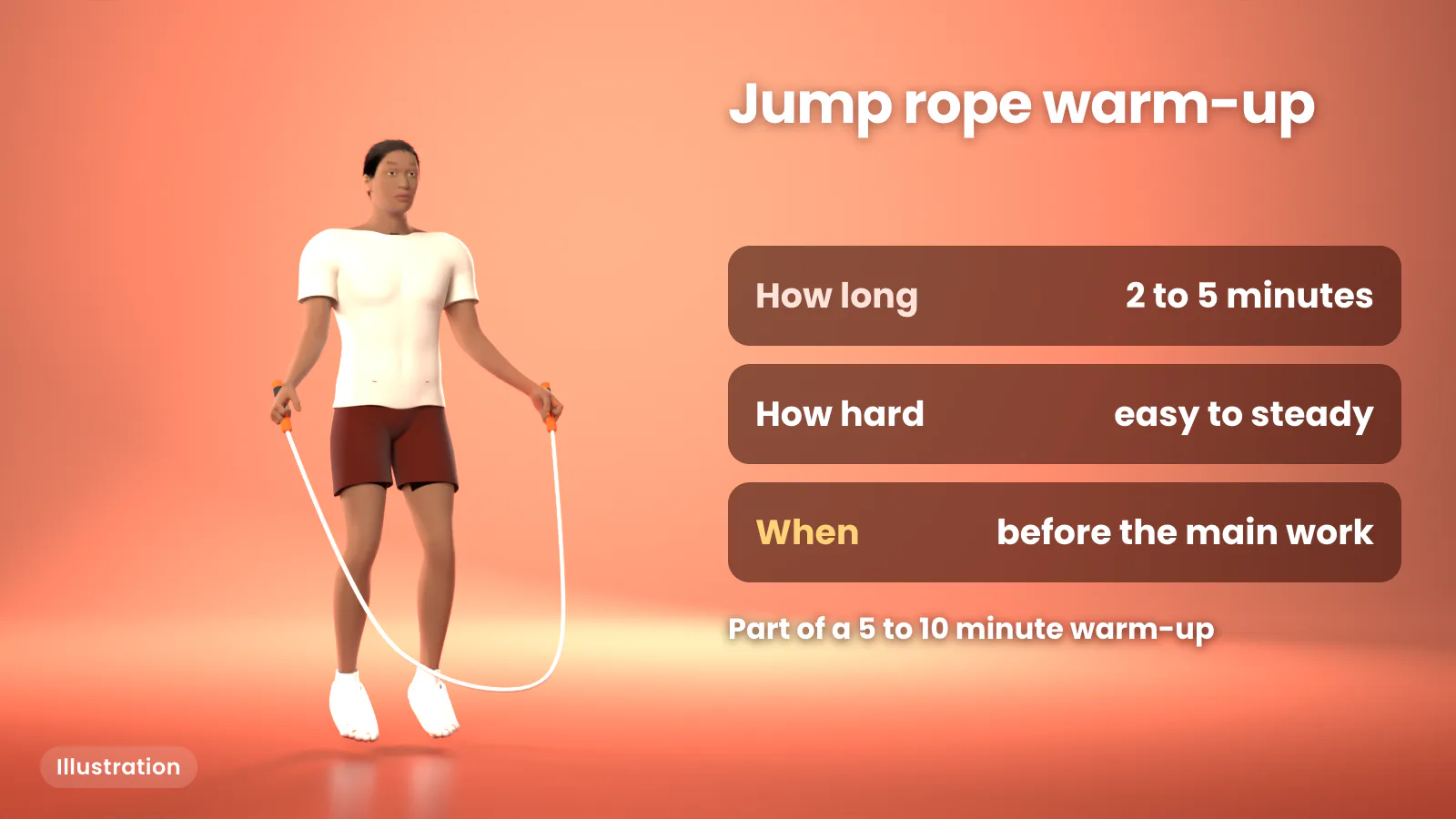
Use 2 to 5 minutes of easy to steady skipping as part of a 5 to 10 minute warm-up, before the main part of your workout. In a 2013 study of 12 track and field athletes, a warm-up with rope jumps raised jump height and power as much as one with traditional jumps, and improved bounding distance more. In a 2020 trial, 96 runners swapped 5 minutes of their warm-up for rope jumping 2 to 4 times a week and ran a faster 3 km after 10 weeks.
A jump rope is one of the quickest warm-ups there is: two minutes and your heart rate is up, your calves and feet are awake, and you have practised the quick, springy contacts that running and jumping need. Here is what research shows, a 5-minute routine to copy, and when to skip before or after your workout.
What the studies show
Two studies have tested rope jumping as a warm-up:
- Track and field athletes, 2013. 12 national-level athletes tried three warm-ups in random order: jogging and stretching only, the same plus traditional jumps, and the same plus rope jumps. Both jump warm-ups raised peak power and jump height more than jogging and stretching alone. The rope version also improved distance in five alternate-leg bounds more than the traditional jumps did. The author concluded that rope jumps may suit horizontal jumping tasks best.
- Amateur runners, 2020. 96 runners were split into two groups. One swapped 5 minutes of their usual warm-up for rope jumping, 2 to 4 times a week, 10 to 20 minutes in total a week. After 10 weeks they had improved their 3 km time trial, jump tests, reactive strength and foot-arch stiffness; the group that kept its usual warm-up did not change.
So a few minutes of skipping before training can do more than warm you up: done regularly, it trains the springy, reactive side of your legs.
A 5-minute jump rope warm-up
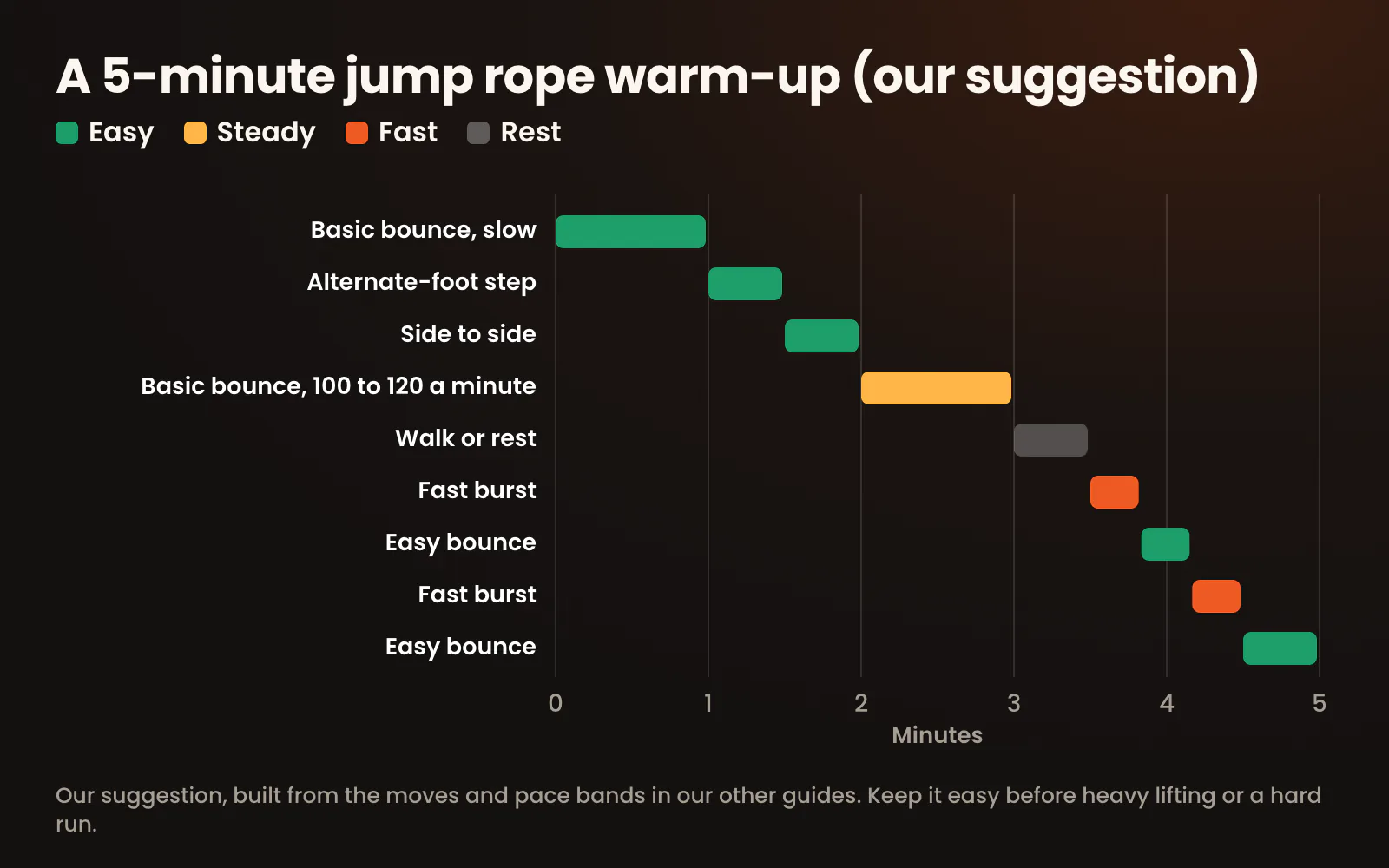
Our suggestion, from easy to steady:
| Time | Move | Pace |
|---|---|---|
| 0:00 to 1:00 | Basic bounce | Slow |
| 1:00 to 1:30 | Alternate-foot step | Easy |
| 1:30 to 2:00 | Side to side | Easy |
| 2:00 to 3:00 | Basic bounce | Steady, 100 to 120 a minute |
| 3:00 to 3:30 | Walk or rest | |
| 3:30 to 3:50 | Fast burst | Fast |
| 3:50 to 4:10 | Basic bounce | Easy |
| 4:10 to 4:30 | Fast burst | Fast |
| 4:30 to 5:00 | Basic bounce | Easy |
The moves are in our jump rope exercises, and the paces in our guide to jumps per minute. Before heavy lifting or a hard run, drop the fast bursts. Harvard Health suggests 5 to 10 minutes of warm-up activity in total, so follow the rope with a few minutes of movements that match your main workout.
Before or after your workout?
- Before, as a warm-up: 2 to 5 easy to steady minutes. It warms the lower legs and raises your heart rate without tiring you. This is the use the studies above tested.
- After, as a finisher: a few short intervals, such as 6 rounds of 20 seconds on and 40 seconds off, if your legs still have good form. Stop when your hops get heavy or you start to trip.
- On its own: for a full rope workout, use our beginner routines, with their own warm-up and cool-down.
The one combination we'd avoid is a long, hard rope session right before heavy leg training, because tired calves make landings and lifts sloppier.
Stretching and cooling down
Our suggestion: before you start, keep moving rather than holding long stretches, with slow skipping, ankle circles and a few calf raises. After the session, walk for 2 to 3 minutes and let your breathing settle. If your calves feel tight, gentle calf stretches afterwards are a good place for them. Our article on jump rope muscles explains why the calves feel it most.
Count your warm-up
A warm-up is easier to repeat when you know what you did. SkipCount counts every jump with the iPhone camera, says the count out loud and shows your total, best set and pace when you finish, so you can see whether your warm-up stays the same from session to session. Your first 3 workouts are free; after that, counting, timers and full history are part of SkipCount Pro.
Download SkipCount and count your next warm-up.
Questions
Is jump rope a good warm-up?+
Yes. It raises your heart rate quickly, warms up the calves, ankles and feet, and practises quick, springy contacts. In a 2013 study, a rope-jump warm-up improved jump height and power as much as a warm-up with traditional jumps, and both beat jogging and stretching alone.
How long should I jump rope to warm up?+
About 2 to 5 minutes, as part of a 5 to 10 minute warm-up. Start slow and build to a steady pace; save hard intervals for the main workout. The runners in a 2020 trial used 5 minutes.
Should I jump rope before or after a workout?+
Both work, for different jobs. Before: a few easy minutes as a warm-up, so it does not tire you for lifting or running. After: as a short interval finisher, if your legs are still fresh enough for good form.
Should I stretch before jumping rope?+
Our suggestion: start with easy movement such as slow skipping, ankle circles and a few calf raises, and save longer calf stretches for after the session, if they feel good.
Is jump rope a good warm-up before lifting?+
Yes, if you keep it easy and short. Two to five minutes raises your temperature and heart rate without tiring the legs before squats or deadlifts.
Sources
- Makaruk H. Acute effects of rope jumping warm-up on power and jumping ability in track and field athletes. Pol J Sport Tourism, 2013 (checked 2026-11-18)
- García-Pinillos F, et al. Jump-rope training: improved 3-km time-trial performance in endurance runners. Int J Sports Physiol Perform, 2020 (checked 2026-11-18)
- Harvard Health Publishing: The best exercises for your warm-up (checked 2026-11-18)