How many jumps per minute is good? Jump rope speed, explained
 By Rupangkan KalitaUpdated
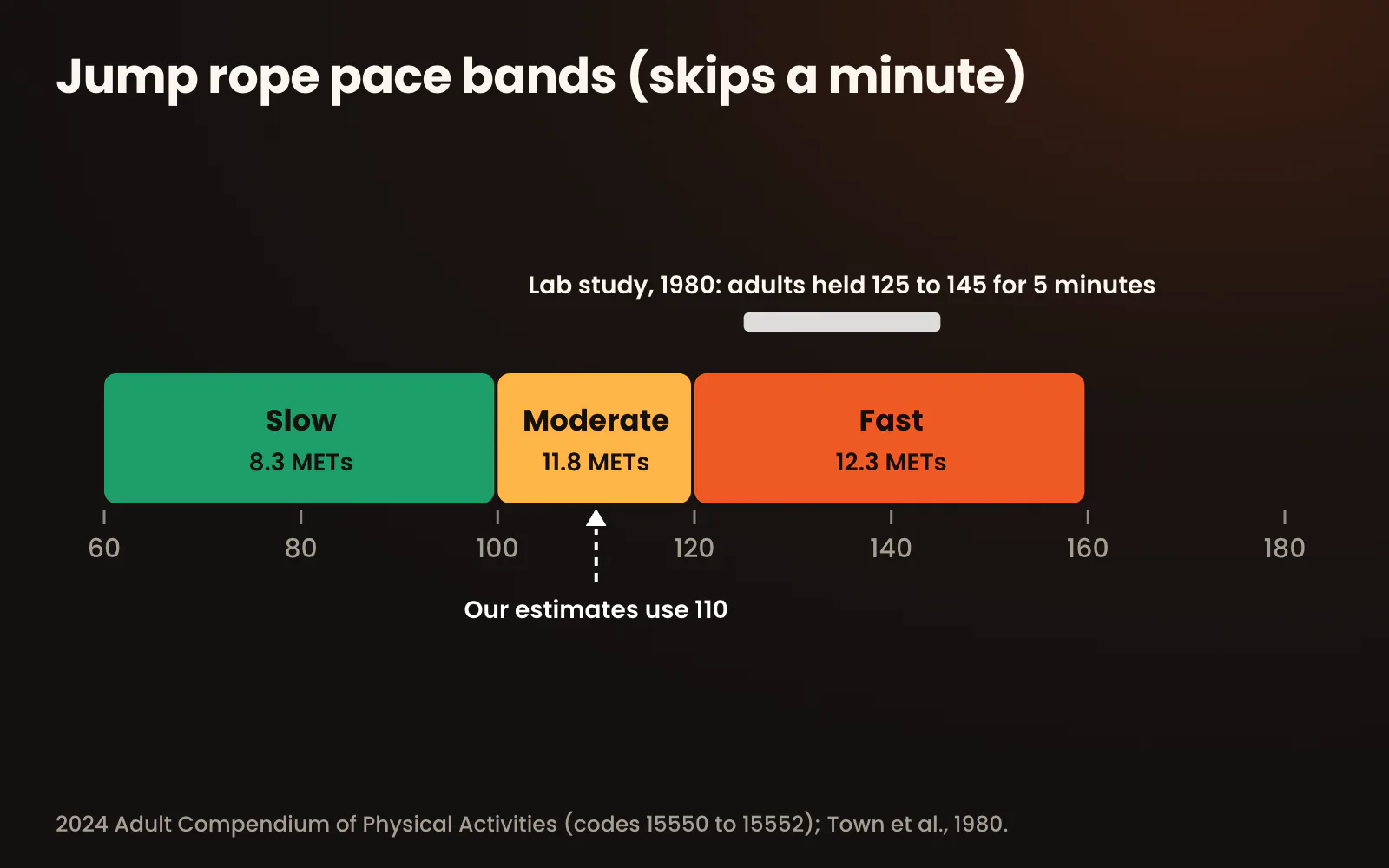
100 to 120 jumps a minute is a good steady pace: the Compendium of Physical Activities calls it moderate, and our estimates use 110. Under 100 is slow and 120 to 160 is fast. Speed matters less than it looks: in a 1980 lab study, going from 125 to 145 skips a minute barely changed heart rate, because people jump lower when they turn faster.

"How many jumps a minute should I do?" has a simple answer and a more useful one. The simple answer is 100 to 120, the moderate band in the Compendium of Physical Activities. The useful one is that a pace you can hold matters more than the number, because speed changes less than most people expect.
The three pace bands
| Pace | Jumps a minute | METs | kcal a minute at 70 kg |
|---|---|---|---|
| Slow | under 100 | 8.3 | 10.2 |
| Moderate | 100 to 120 | 11.8 | 14.5 |
| Fast | 120 to 160 | 12.3 | 15.1 |
A MET says how many times more energy an activity uses than sitting still, and 6 or more counts as vigorous. All three bands are well above that, so even slow skipping is a hard workout. Our calorie calculator uses these values with your own weight.
Does faster mean a better workout?
Less than you would think. In a 1980 lab study, 30 adults skipped for 5 minutes at 125, 135 and 145 skips a minute. Their heart rate barely moved between the three speeds, averaging 176 to 177 beats a minute, because people jump lower as they turn faster. Only very fast skipping, 160 a minute in the men, cost clearly more. Our cardio article has the full numbers.
The Compendium shows the same pattern: the big step is from slow to moderate (8.3 to 11.8 METs); moderate to fast adds only 0.5.
So for most workouts, pick a pace you can keep for the whole set. Use speed on purpose, in short fast intervals, not by accident.
What pace to aim for
These are our suggestions:
- Learning or long sets: whatever you can hold with clean form. Under 100 is fine and still vigorous.
- Steady sets: 100 to 120. It is the pace our beginner routines and estimates use (110).
- Fast intervals: 120 and up, for 20 to 30 seconds, then a full rest.
Test your speed in 60 seconds
- Warm up for 2 to 3 minutes.
- Jump the basic bounce for 60 seconds at a pace you could hold for longer. Count every jump; a trip does not stop the clock.
- Write the number down and repeat the test once a week, at the same time of day.
That is your steady pace. A second test at full speed for 30 seconds, doubled, gives a rough fast pace.
How to jump faster
- Lower hops: 2 to 3 cm is enough to clear the rope. Height costs time on every jump.
- Wrists, not arms: elbows close to your sides, small circles from the wrists.
- The right rope length: stand on the middle; for a beginner the handles should reach about your armpits. A rope that is too long slows every turn.
- Short fast sets: 20 to 30 seconds at your fastest clean pace, then a full rest, a few times a week. Count misses as well as jumps.
- A lighter rope: a thin, light rope turns faster with the same wrist effort; a heavier one is easier to time while you learn.
If you have joint, heart or other health problems, check with your doctor before adding fast intervals.
See your pace after every set
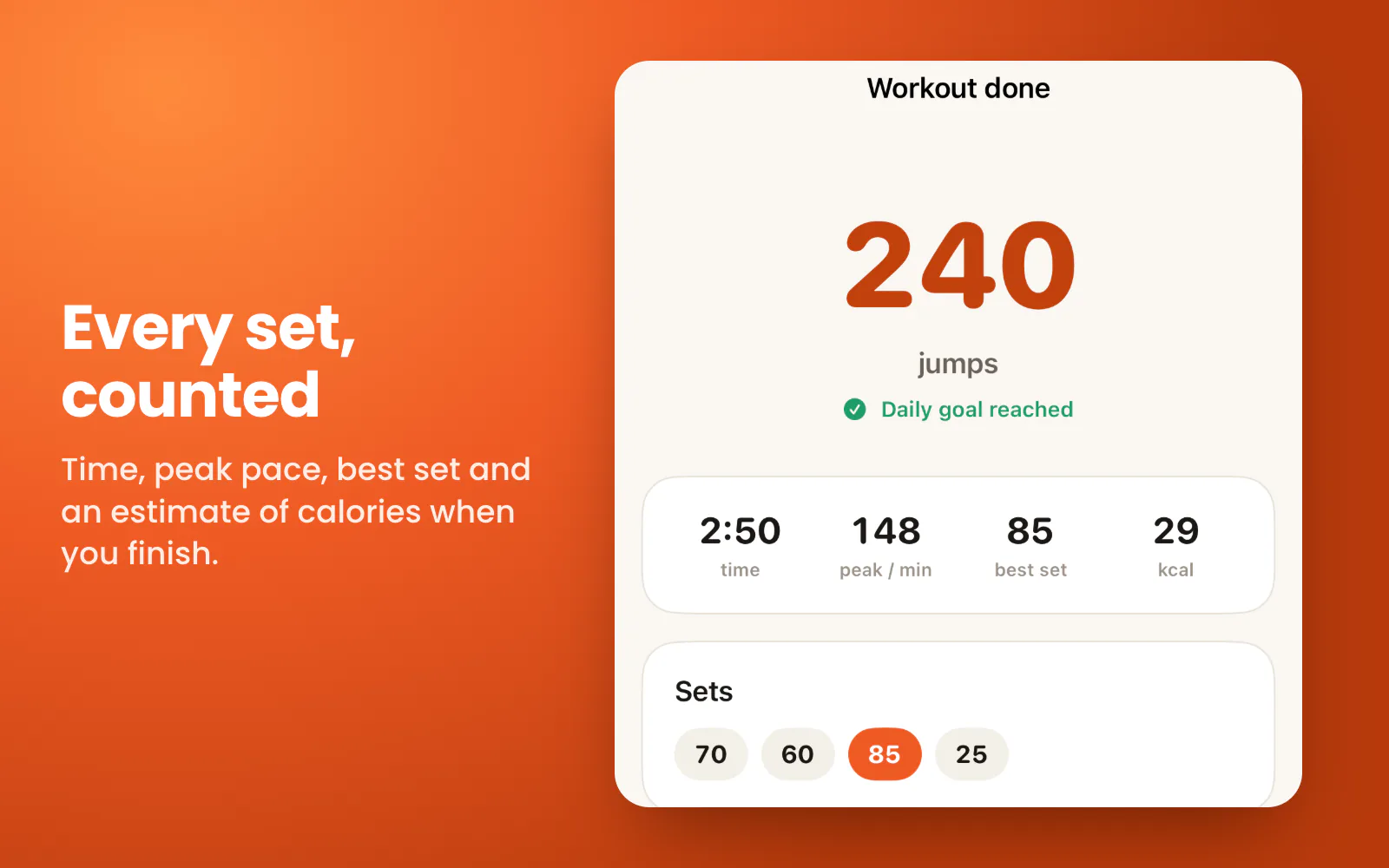
Counting in your head and watching a clock at the same time is hard at 120 a minute. SkipCount counts with the iPhone camera while you jump, says the count out loud, and shows your peak pace per minute, your best set and your time when you finish. Your first 3 workouts are free; after that, counting, timers, goal mode and full history are part of SkipCount Pro.
Download SkipCount and run your 60-second test with every jump counted.
Questions
How many jumps per minute is good?+
100 to 120 is a good steady pace, the Compendium's moderate band. Under 100 is slow and still vigorous exercise; 120 to 160 is fast. A pace you can hold for the whole set beats a faster one that falls apart after 20 seconds.
How many jumps per minute should a beginner do?+
Whatever you can hold with clean form for 30 seconds. If that is under 100, the Compendium still counts it as vigorous. Rhythm and longer sets come first; speed can follow.
Does jumping rope faster burn more calories?+
A little. At 70 kg the Compendium values give about 10.2 kcal a minute below 100 skips, 14.5 at 100 to 120 and 15.1 at 120 to 160. The step from slow to moderate matters most; moderate to fast adds little.
How many jumps is 10 minutes of jump rope?+
About 1,000 to 1,200 at a moderate 100 to 120 a minute, with no rests. At our usual estimate of 110 a minute it is about 1,100.
How do I jump rope faster?+
Keep the hop to 2 to 3 cm, turn from the wrists with your elbows close, and use a rope of the right length. Practise short fast sets of 20 to 30 seconds with full rests, then count a 60-second test once a week.