Is jump rope good cardio? What heart rate and oxygen studies show
 By Rupangkan KalitaUpdated
Yes. Jumping rope is vigorous cardio at every pace that has been measured: 8.3 to 12.3 METs, against 6 for the start of vigorous activity. In a 1980 lab study, adults averaged 177 beats a minute. It is also partly anaerobic, so most people need short sets at first. Trials show cardio fitness gains in 6 to 12 weeks.

Jump rope has a reputation as the cardio you can do in a hallway. The lab data backs that up, with one catch most articles skip: for many people it is so hard that it stops being steady cardio after a minute or two. Here is what the measurements show, and how to use rope for your heart without burning out in the first set.
Is jump rope good cardio?
Yes. Every rope pace in the 2024 Adult Compendium of Physical Activities sits well inside the vigorous range. The CDC counts anything from 6 METs up as vigorous; rope starts at 8.3 METs for a slow pace and reaches 12.3 for a fast one. A MET is how many times more energy an activity takes than sitting still.
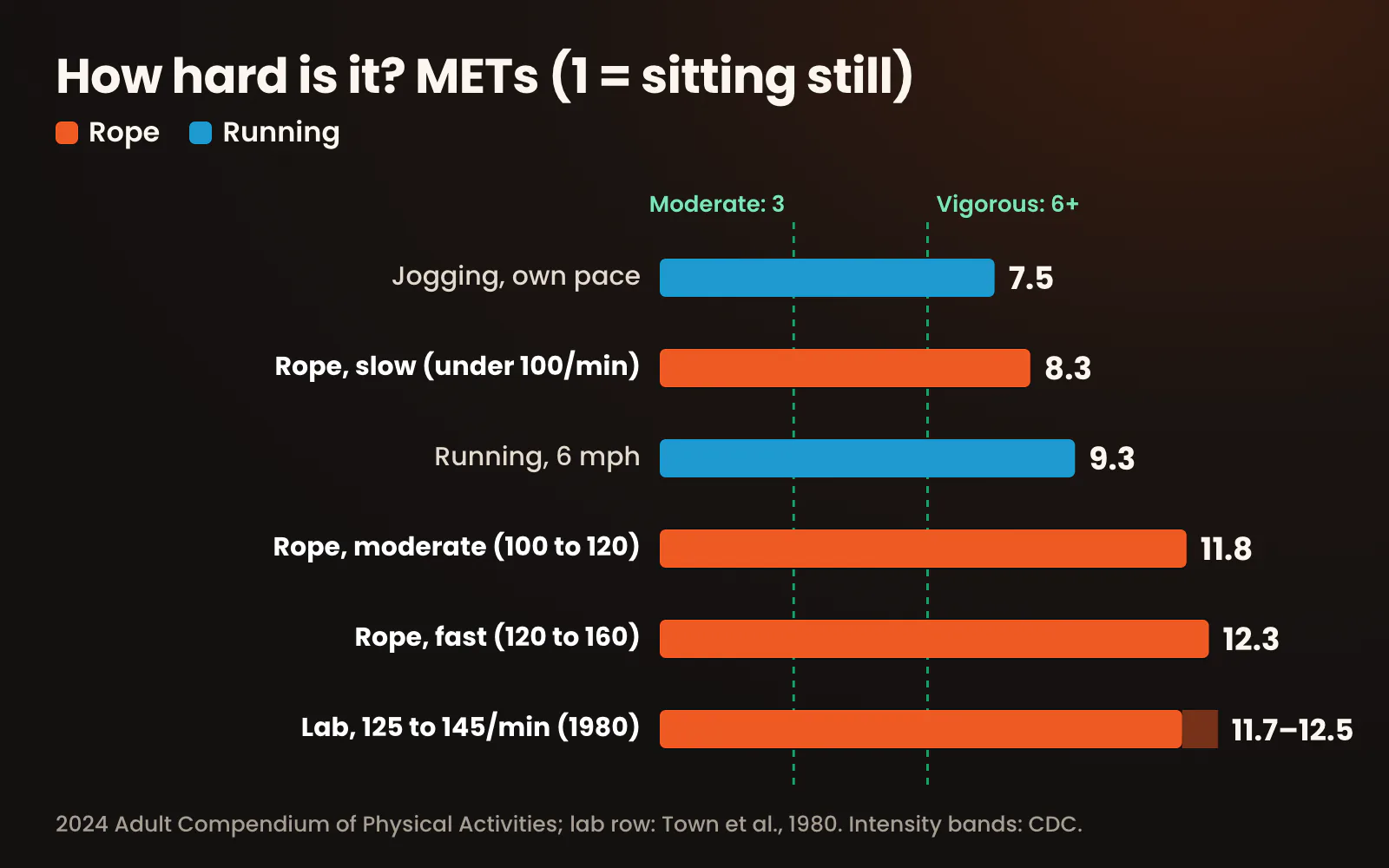
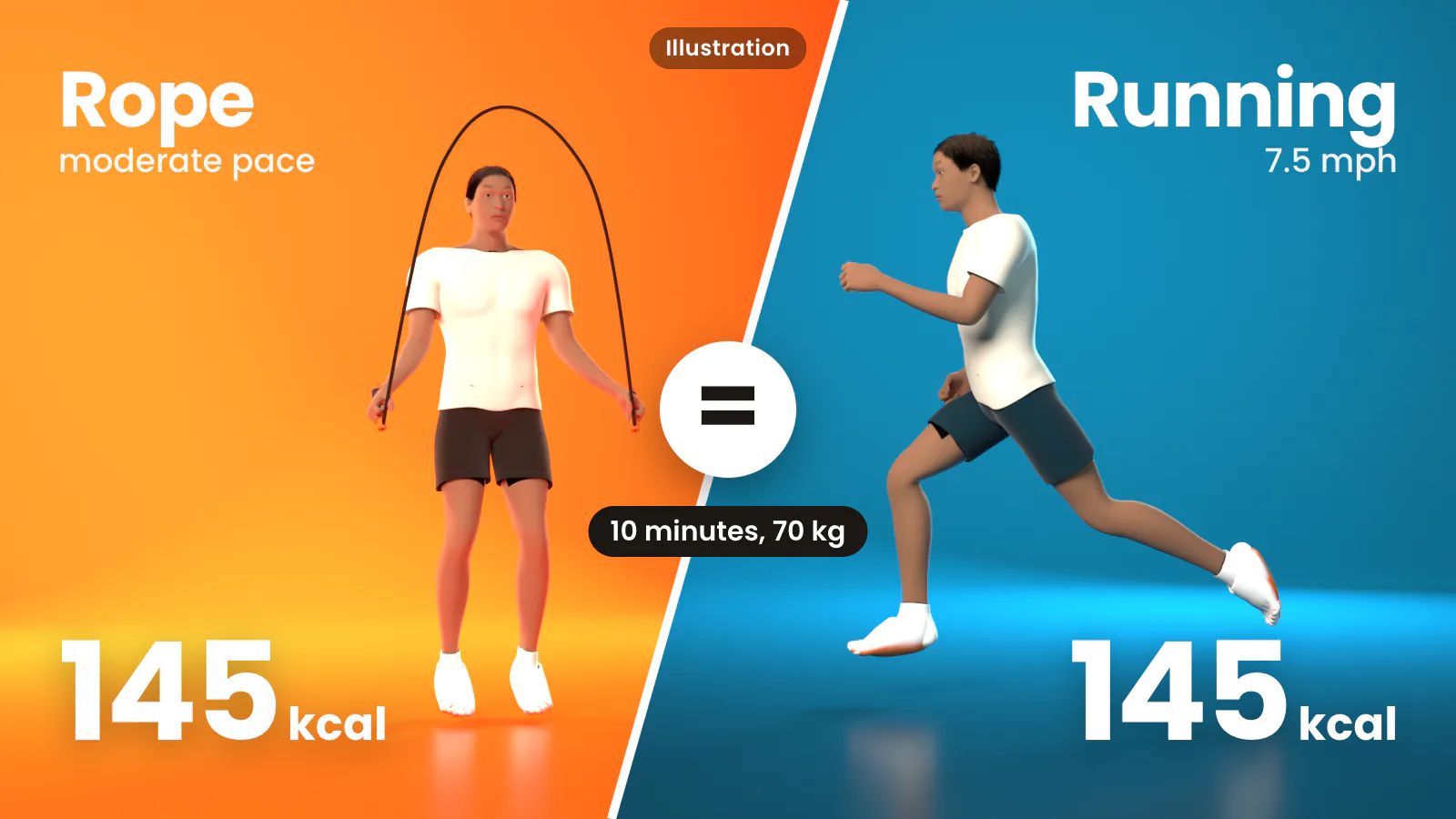
A moderate rope pace is harder than a 6 mph run and about equal to running at 7.5 mph. Our jump rope vs running comparison turns those numbers into calories.
What happens to your heart rate
Two lab studies from the early 1980s measured people while they skipped, collecting their breath through a hollow rope handle so they never had to stop.
| Study | Who | Pace | Heart rate | Oxygen use |
|---|---|---|---|---|
| Town 1980 | 19 men, 11 women | 125, 135, 145 skips a minute for 5 minutes each | 176 to 177 bpm | 41 to 42.5 mL/kg/min, 11.7 to 12.5 METs |
| Quirk 1982, women | 6 women | 120, 140, 160 turns a minute | 181 bpm | 92% of their maximum |
| Quirk 1982, men | 6 men | 120, 140, 160 turns a minute | 166 to 178 bpm | 76% to 88% of their maximum |
Two things stand out. First, these are high numbers for any workout: the women in the second study reached 181 bpm, close to the 185 they hit in an all-out bike test. Second, speed made little difference. Going from 125 to 145 skips a minute moved heart rate by one beat, because people jump lower when they turn faster. Only very fast skipping (160 a minute in the men) cost clearly more.
Is jump rope aerobic or anaerobic?
Both, and that is the honest answer to "is it good cardio". In the 1982 study, the women's blood lactate after skipping matched what they reached after a maximal bike test. In the 1980 study, the ratio of carbon dioxide breathed out to oxygen taken in was above 1.0 at every pace, a sign that the body was topping up its energy without oxygen.
Skill changes this. A 1988 study of experienced jumpers found they need less oxygen at the same speed, and that the alternate-foot step (a light jog in place over the rope) was the most efficient of five techniques. Even so, a small group of them kept a high enough intensity through a typical workout to count as training. For a beginner, rope behaves more like intervals: hard, then a pause.
Does it actually improve your cardio fitness?
Training studies say yes, with an important caveat about how long people trained.
- The best overview: a 2022 meta-analysis pooled 21 trials with 1,021 participants, 18 of them with young people under 18. Rope training improved cardiorespiratory endurance and lowered resting heart rate compared with control groups. It found no clear effect on blood pressure.
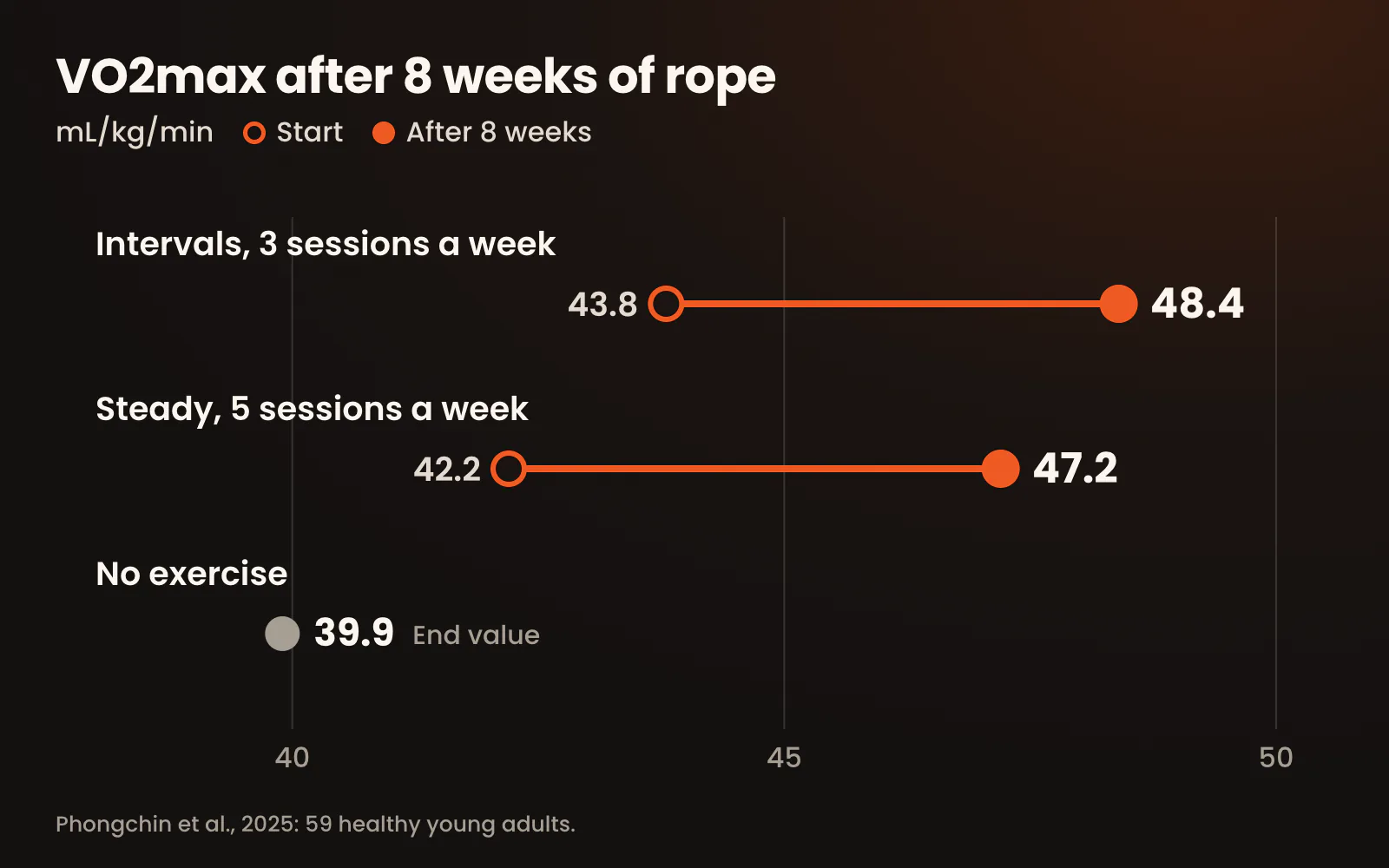
- Young adults, 8 weeks: in a 2025 trial, VO2max (the standard measure of cardio fitness) rose from 43.8 to 48.4 mL/kg/min with rope intervals three times a week (9 × 2 minutes at 80% of maximum heart rate), and from 42.2 to 47.2 with 30 steady minutes five times a week (70% of maximum). That is about 10% and 12%.
- Teenagers with overweight, 12 weeks: interval rope in school PE classes, three times a week, improved cardio fitness and body fat percentage in both rope groups; the control group did not train.
- Sedentary adults, 6 weeks: 10 minutes of rope five times a week raised VO2max by 7%, while 30 minutes of jogging raised it by 13%.
Not every trial is positive. In a 2025 study of 92 Chinese college students, the jogging group improved its 800 m or 1,000 m test, while the rope group's scores went down. The authors suspect the rope group lacked the leg strength to train hard enough. It is a reminder that rope only works as cardio if you can keep going long enough to get the dose.
How to use jump rope as steady cardio
This is our suggestion, built on the studies above:
- Start with intervals, not a long set. Work periods of 30 seconds to 2 minutes with a short rest. The 2025 trial's 2-minute bouts with 1 minute of light recovery are a good target.
- Use the alternate-foot step once you have the basic bounce. It was the most efficient technique in the 1988 study, so you can keep going longer at the same pace.
- Don't chase speed. A faster turn barely raised the heart rate in the lab. Steady and relaxed beats frantic.
- Use the talk test. The CDC's rule: at vigorous effort you can say only a few words before pausing for a breath. If you can't speak at all, rest.
- Count only rope time. For a weekly target of 75 minutes, see how long to jump rope a day.
Track the minutes that count
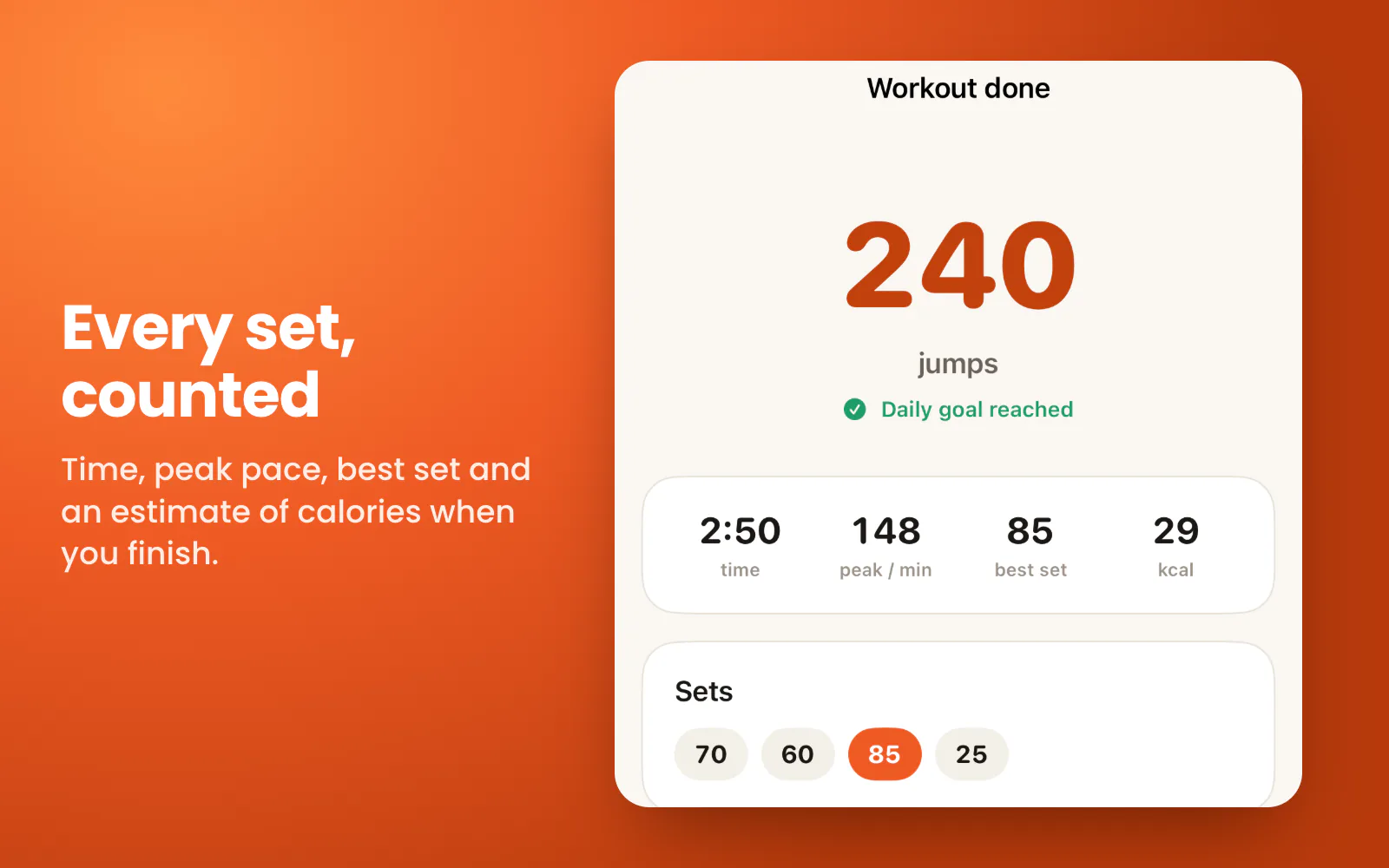
Cardio from rope comes down to minutes with the rope turning, and those are hard to judge by feel when you stop every minute. SkipCount counts your jumps with the iPhone camera, says the count out loud, and shows each set, your peak pace and your time on the rope when you finish. Your first 3 workouts are free.
Download SkipCount and see how much cardio your next session really holds.
Questions
Is jump rope better cardio than running?+
Per minute it is harder: a moderate rope pace of 100 to 120 skips is 11.8 METs, about the same as running at 7.5 mph, and above a 6 mph run (9.3). Over a whole workout running usually wins, because most people can run for 30 minutes long before they can skip that long.
Is jump rope aerobic or anaerobic?+
Both. Lab studies found oxygen use close to the maximum and blood lactate as high as after an all-out bike test in some people. Experienced jumpers use less energy at the same speed and can stay aerobic longer. Beginners tire fast, which is why short sets work best.
What heart rate should I reach when jumping rope?+
You will rarely need to push. Lab subjects averaged 176 to 177 beats a minute after 5 minutes. A 2025 trial used 70% of maximum heart rate for its steady sessions and 80% for its intervals, and both improved fitness.
How many minutes of jump rope count as a cardio workout?+
Fifteen minutes on five days meets the WHO minimum of 75 vigorous minutes a week. In a 1986 trial, 10 minutes a day on five days raised VO2max by 7% in 6 weeks. See our guide on how long to jump rope.
Does skipping faster give a better cardio workout?+
Less than you would think. In the 1980 lab study, going from 125 to 145 skips a minute barely changed heart rate or oxygen use, because people jump lower as they speed up. Very fast skipping does cost more.
Sources
- Town GP, Sol N, Sinning WE. The effect of rope skipping rate on energy expenditure of males and females. Med Sci Sports Exerc, 1980 (checked 2026-11-09)
- Quirk JE, Sinning WE. Anaerobic and aerobic responses of males and females to rope skipping. Med Sci Sports Exerc, 1982 (checked 2026-11-09)
- Solis K, et al. Aerobic requirements for and heart rate responses to variations in rope jumping techniques. Phys Sportsmed, 1988 (checked 2026-11-09)
- Singh U, et al. Jump rope training effects on health- and sport-related physical fitness in young participants: a systematic review with meta-analysis. J Sports Sci, 2022 (checked 2026-11-09)
- Phongchin W, et al. Effects of high-intensity interval rope-skipping on cardiorespiratory fitness, body composition, and enjoyment in young adults. Eur J Clin Nutr, 2025 (checked 2026-11-09)
- Buyze MT, et al. Comparative training responses to rope skipping and jogging. Phys Sportsmed, 1986 (checked 2026-11-06)
- Shao S, Cao M. Integrating interval jump rope exercise into a school setting improve body composition, cardiorespiratory fitness and glycolipid metabolism parameters in adolescents with overweight and obesity. BMC Pediatr, 2025 (checked 2026-11-09)
- Chen Y, et al. Differential impacts of jogging and rope skipping in college students in China. Front Public Health, 2025 (checked 2026-11-09)
- 2024 Adult Compendium of Physical Activities: Sports (rope jumping, codes 15550 to 15552) (checked 2026-11-03)
- CDC: Measuring physical activity intensity (checked 2026-11-08)