How long should you jump rope a day? Minutes and jumps by goal
 By Rupangkan KalitaUpdated
For most adults, 10 to 15 minutes of actual jumping a day is plenty. Fifteen minutes on five days meets the WHO minimum of 75 vigorous minutes a week, about 1,650 jumps a day at 110 a minute. Rope studies used less and still saw gains. Beginners should start nearer 3 minutes.

Most people ask how long to jump rope when what they want to know is how much is enough. There are two good yardsticks: what the public health guidelines ask for each week, and what the rope studies actually used. They give similar answers, and both come out shorter than most people expect.
All the minutes on this page mean time with the rope turning. Rest breaks don't count.
How long should you jump rope a day?
Jumping rope is vigorous activity. The CDC lists it among its vigorous examples, and all three rope paces in the 2024 Compendium of Physical Activities (8.3, 11.8 and 12.3 METs) are above the 6 METs where vigorous starts. The WHO asks adults for 75 to 150 minutes of vigorous activity a week, or 150 to 300 moderate minutes, or a mix.
| Goal | Per week | On 5 days | Every day |
|---|---|---|---|
| WHO minimum for adults | 75 minutes of vigorous activity | 15 minutes | About 11 minutes |
| Upper end of the WHO range | 150 minutes | 30 minutes | About 21 minutes |
| Children and teens, 6 to 17 (US guidelines) | 60 minutes of moderate-to-vigorous activity a day, from any activity |
Rope doesn't have to cover all of it. Running, cycling or a brisk walk count too, at their own intensity. The US guidelines also dropped the old rule that only bouts of 10 minutes or more count, so short sets add up.
How long did the rope studies use?
These are the doses from the trials behind our benefits article. Each one is weekly time on the rope.
| Study | Who | What they did | Result |
|---|---|---|---|
| Buyze 1986 | 26 sedentary adults | 10 minutes, 5 a week, for 6 weeks | VO2max up 7% (30 minutes of jogging: up 13%) |
| Phongchin 2025 | 59 young adults | Nine 2-minute bouts, 3 a week, for 8 weeks | VO2max 43.8 to 48.4 mL/kg/min |
| Phongchin 2025 | Same trial | 30 minutes steady, 5 a week, for 8 weeks | VO2max 42.2 to 47.2 mL/kg/min |
| Lin 2025 | University students | 1,000 jumps, 4 a week, for 8 weeks | Weight down 1.5 kg (control: up 0.2 kg) |
| Tang 2021 | University students | 1,500 jumps, 3 a week, for 8 weeks | Weight down 0.6 kg, not statistically significant |
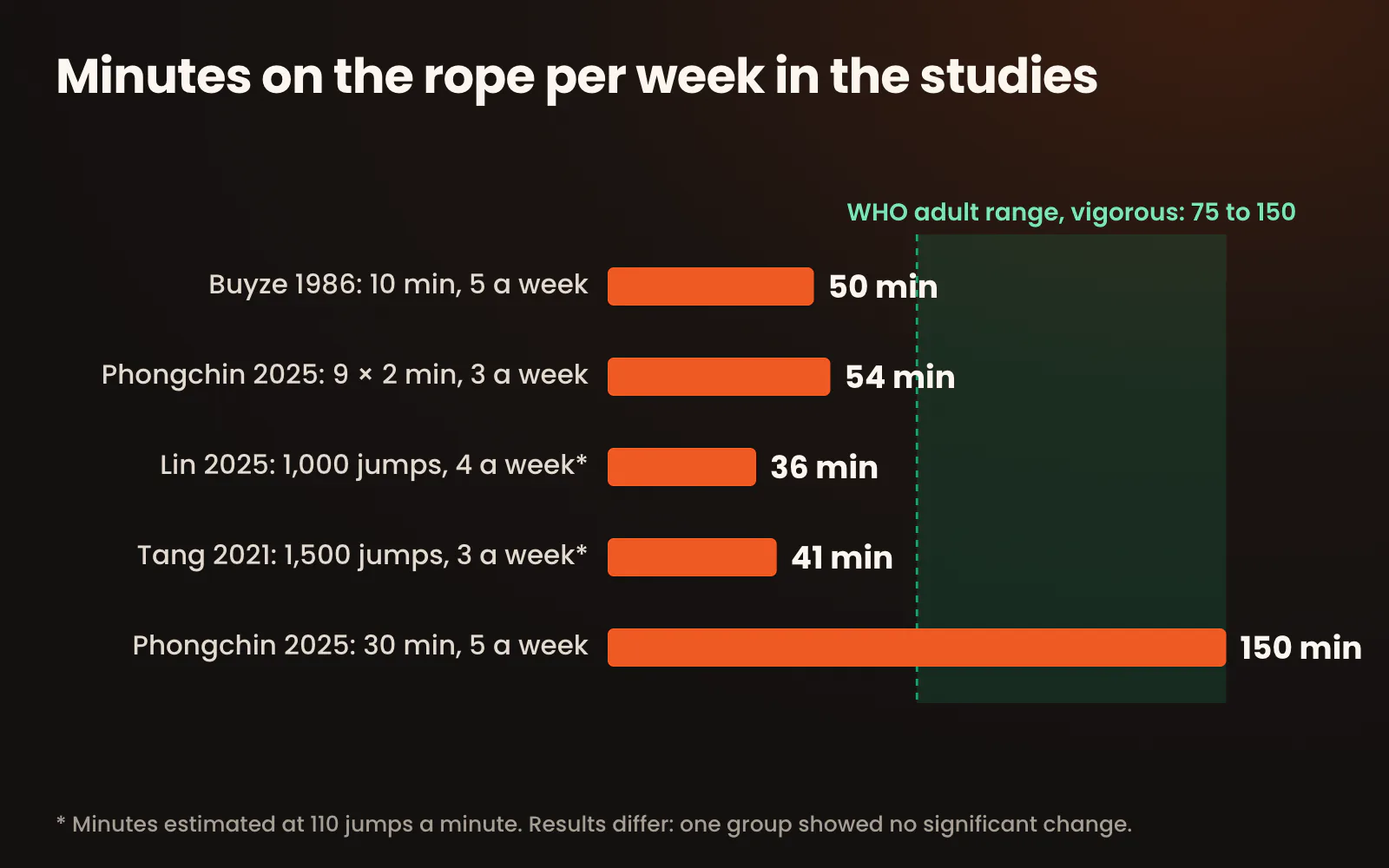
Four of the five groups trained below the WHO minimum, and three of those four still improved. So 36 to 54 minutes of rope a week was enough for measurable results in these trials. It is not enough to meet the full guideline from rope alone.
How many jumps a day is that?
Count your jumps and you can convert time to jumps. Our calorie calculator uses 90, 110 and 140 jumps a minute for slow, moderate and fast.
| Rope time a day | Slow, 90 a minute | Moderate, 110 a minute | Fast, 140 a minute |
|---|---|---|---|
| 5 minutes | 450 | 550 | 700 |
| 10 minutes | 900 | 1,100 | 1,400 |
| 15 minutes | 1,350 | 1,650 | 2,100 |
| 20 minutes | 1,800 | 2,200 | 2,800 |
| 30 minutes | 2,700 | 3,300 | 4,200 |
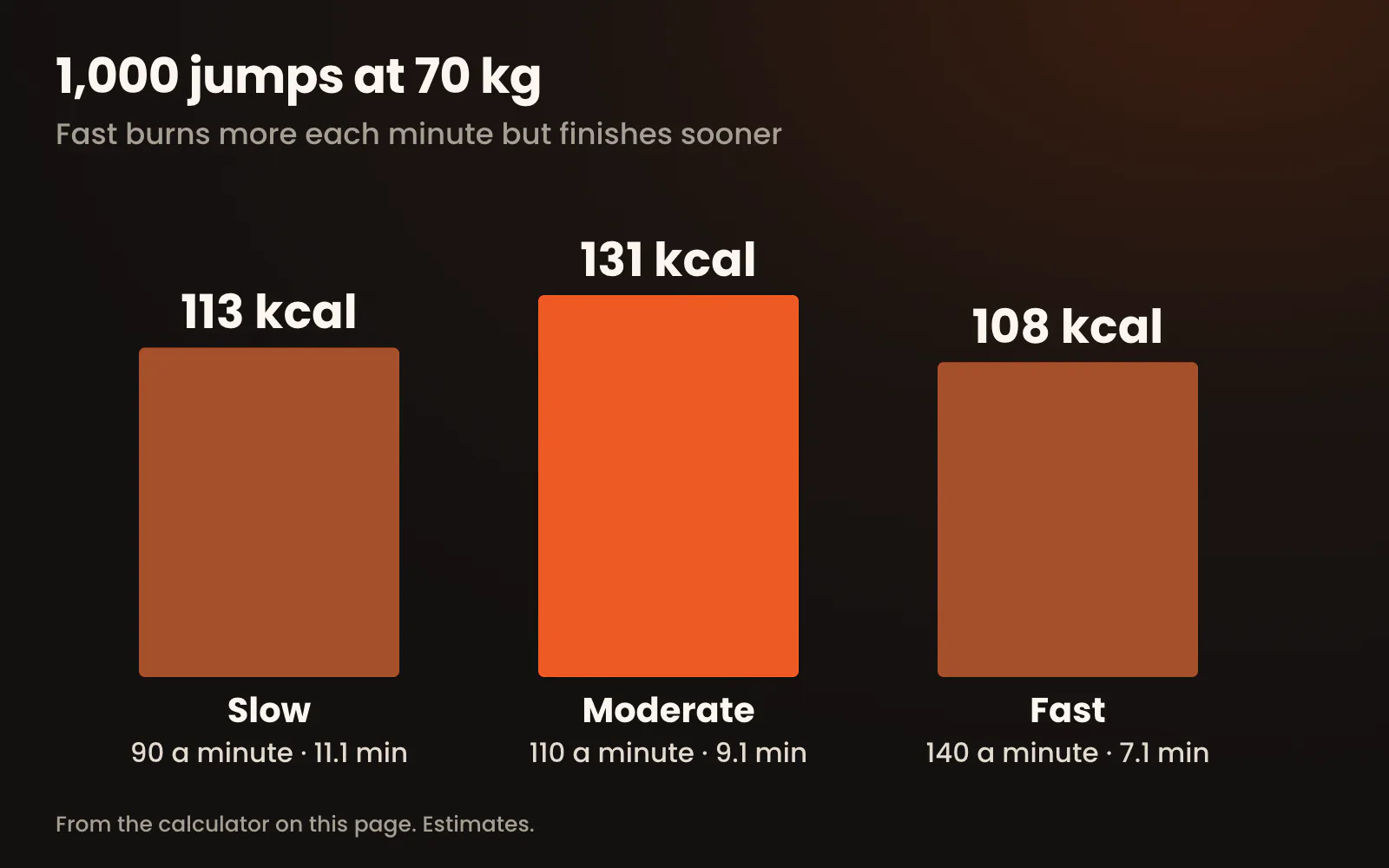
A target of 1,000 jumps a day is a sensible middle: about 9 minutes at a moderate pace, the dose used in the 8-week weight trial above.
How to build up to it
Nobody starts at 15 minutes. Our beginner guide starts with eight 20-second sets, about 2.5 minutes of jumping in week 1, and eight 30-second sets, 4 minutes, in week 2.
After that, our suggestion (not a study protocol) is to add about a minute of jumping time per session each week. Lengthen the sets or add one, and keep the rest. At that rate you reach 10 minutes around week 8 and 15 minutes around week 13.
- Rest days: the trials used 3 to 5 sessions a week. Take a day off whenever your calves or shins are still sore.
- Too much, too soon: in the 1986 trial the rope group had more injuries and drop-outs than the joggers. A sudden jump to long daily sessions is the thing to avoid.
- Check the intensity: the CDC's rule of thumb is that during vigorous activity you can't say more than a few words without pausing for a breath. If you can chat freely, you're at a moderate pace, and moderate minutes count half as much toward the targets above.
Know how long you really jumped
A 20-minute session can hold only 8 minutes of jumping once you count the trips and breaks. SkipCount counts every jump with the iPhone camera, says the number out loud and shows your time, peak pace and best set when you finish. Your first 3 workouts are free.
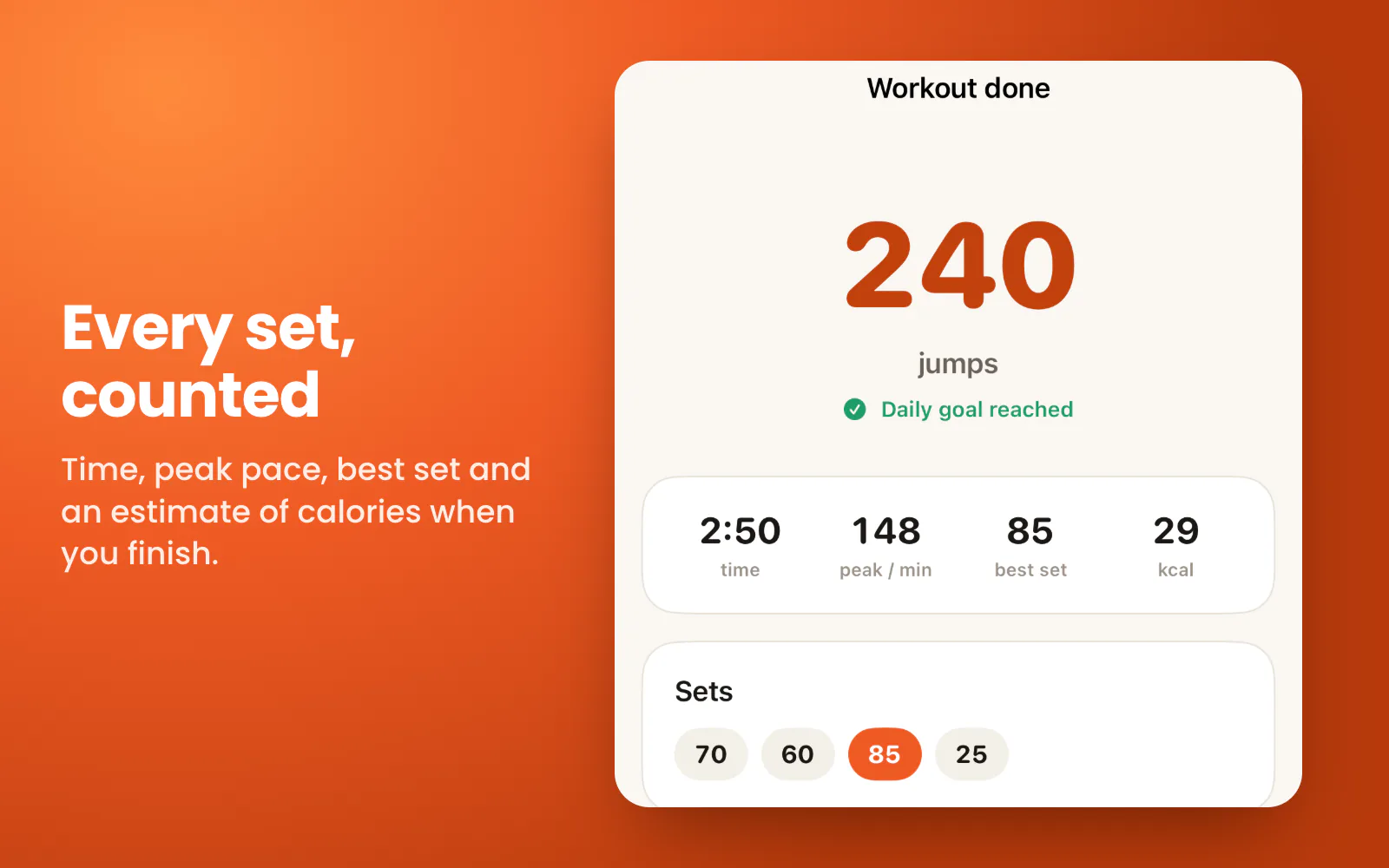
Download SkipCount and see how long your next session really was.
Questions
Is 10 minutes of jump rope a day enough?+
For a fitness gain, it can be. In a 1986 trial, 10 minutes five times a week raised VO2max by 7% in 6 weeks, though 30 minutes of jogging raised it by 13%. Ten minutes every day adds up to 70 minutes a week, just under the WHO minimum of 75 vigorous minutes.
How many jumps a day should I do?+
About 1,000 to 1,650 is a good target once you are past the first weeks: 9 to 15 minutes at 110 jumps a minute. One 8-week weight trial used 1,000 jumps, four times a week.
Can I jump rope every day?+
The studies here used 3 to 5 sessions a week, not 7. Your calves and shins need time to adapt, so take a day off whenever they are still sore, and only add days once your sessions feel easy.
Do rest breaks count as jump rope time?+
Not in this article. The minutes and jump counts here mean time with the rope turning. A 20-minute session with long breaks can hold only 8 minutes of jumping.
How long should children jump rope?+
There is no rope-specific number. US guidelines ask for at least 60 minutes of moderate-to-vigorous activity a day for ages 6 to 17, and rope can be part of it. School rope programs in the studies we read ran over weeks, not single long sessions.
Is 30 minutes of jump rope a day too much?+
Not for a trained person: a 2025 trial had young adults jump 30 minutes at a steady pace, five times a week, for 8 weeks. For a beginner it is far too much at once. Build up first.
Sources
- Bull FC, et al. World Health Organization 2020 guidelines on physical activity and sedentary behaviour. Br J Sports Med, 2020 (checked 2026-11-08)
- US Department of Health and Human Services: Top 10 things to know about the second edition of the Physical Activity Guidelines for Americans (checked 2026-11-08)
- CDC: Measuring physical activity intensity (checked 2026-11-08)
- 2024 Adult Compendium of Physical Activities: Sports (rope jumping, codes 15550 to 15552) (checked 2026-11-03)
- Buyze MT, et al. Comparative training responses to rope skipping and jogging. Phys Sportsmed, 1986 (checked 2026-11-06)
- Phongchin W, et al. Effects of high-intensity interval rope-skipping on cardiorespiratory fitness, body composition, and enjoyment in young adults. Eur J Clin Nutr, 2025 (checked 2026-11-06)
- Lin Z, et al. Comparison of diet and exercise on cardiometabolic factors in young adults with overweight/obesity. MedComm, 2025 (checked 2026-11-05)
- Tang Z, et al. Effects of caloric restriction and rope-skipping exercise on cardiometabolic health. Nutrients, 2021 (checked 2026-11-05)