30-day jump rope challenge: a day-by-day plan from 100 to 1,000 jumps
 By Rupangkan KalitaUpdated
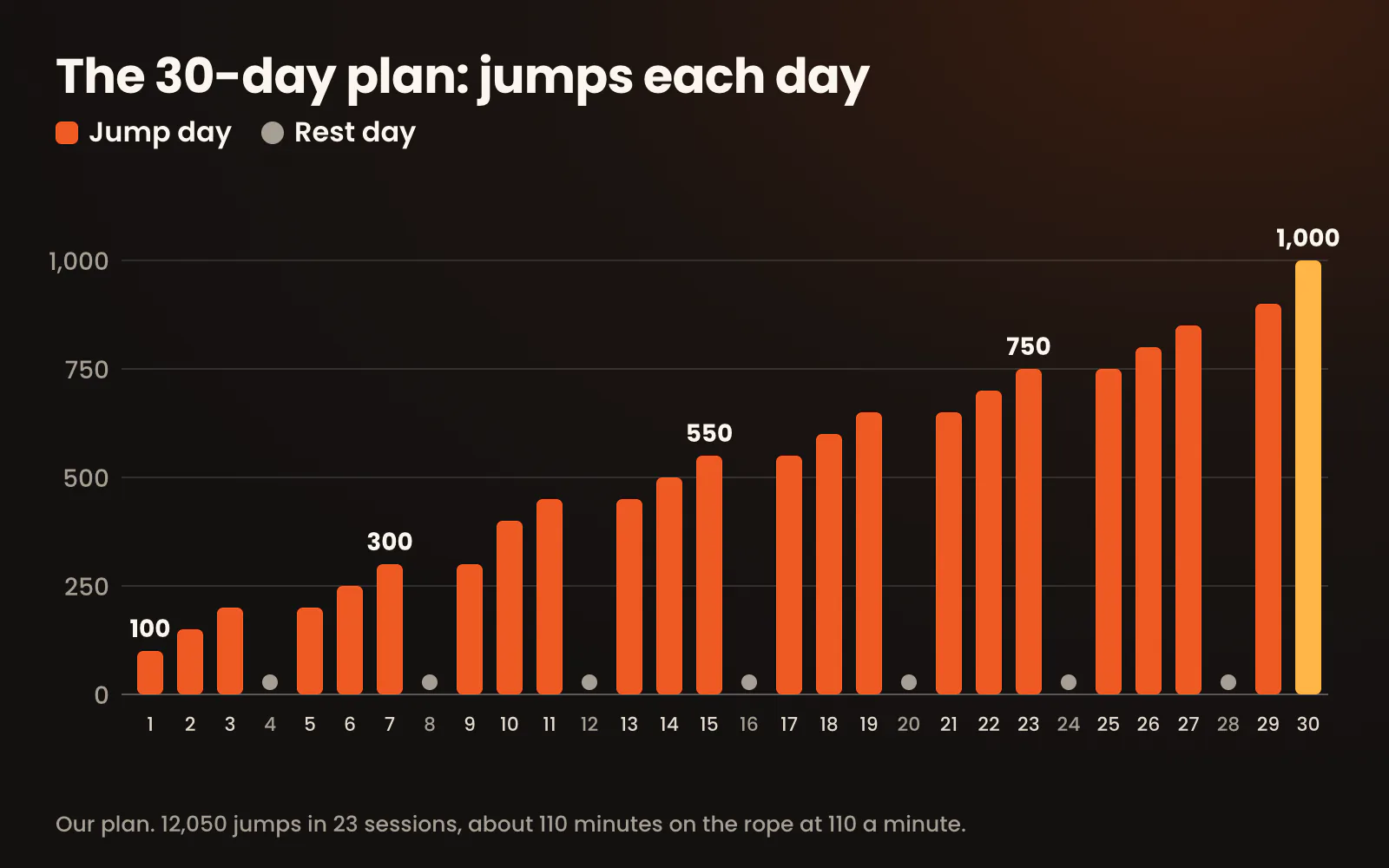
Jump on 23 of the 30 days, with a rest day after every three. Start at 100 jumps in sets of 25 and add about 50 a session, up to 1,000 jumps in sets of 100 on day 30: 12,050 jumps and about 110 minutes on the rope in all. Test your longest unbroken set and your jumps in one minute on day 1 and again on day 30.
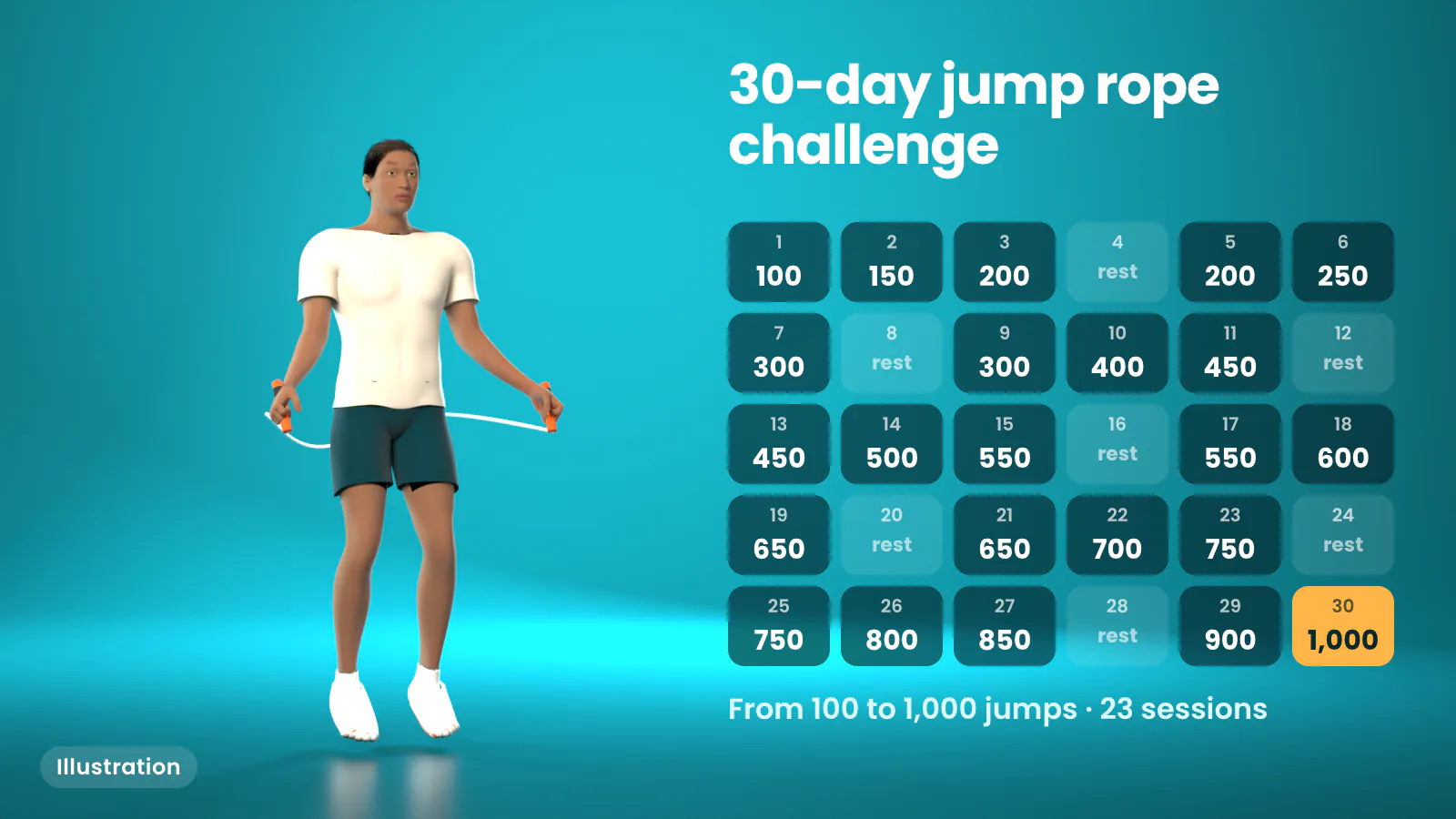
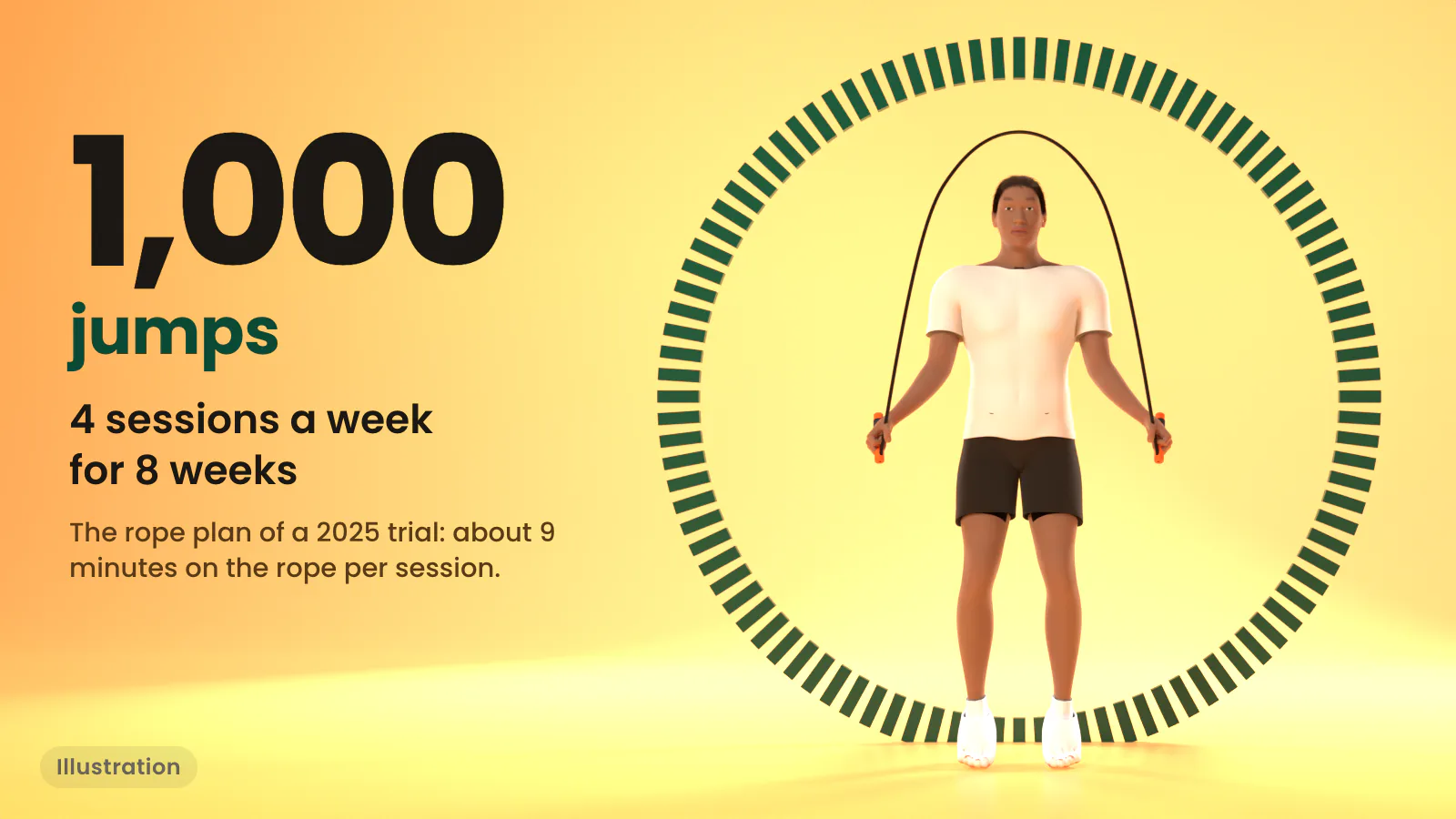
A 30-day challenge works when the daily number rises slowly and the rest days are part of the plan. This one starts at 100 jumps, under a minute on the rope, and ends at 1,000, about 9 minutes. You jump on 23 of the 30 days.
The day targets and rest days are our suggestion. The 1,000-jump finish matches the session used in an 8-week weight trial, and we say below what a month can and can't change.
Who it is for
- You can do the basic bounce for 20 to 30 seconds: both feet together, a 2 to 3 cm hop, the rope turned from the wrists. If not, do the two weeks in our beginner guide first.
- Your calves and shins are pain-free. Soreness the next day is normal at first; pain that is sharp or gets worse while you jump is not.
- If you have joint, heart or other health problems, or have not exercised in a long time, check with your doctor before you start.
The 30-day plan
| Days | Jumps | Sets | Rest between sets |
|---|---|---|---|
| 1, 2, 3 | 100, 150, 200 | 25 jumps each | 30 seconds |
| 5, 6, 7 | 200, 250, 300 | 25 jumps each | 30 seconds |
| 9, 10, 11 | 300, 400, 450 | 50 jumps each | 30 seconds |
| 13, 14, 15 | 450, 500, 550 | 50 jumps each | 30 seconds |
| 17, 18, 19 | 550, 600, 650 | 100 jumps each | 45 seconds |
| 21, 22, 23 | 650, 700, 750 | 100 jumps each | 45 seconds |
| 25, 26, 27 | 750, 800, 850 | 100 jumps each | 45 seconds |
| 29, 30 | 900, 1,000 | 100 jumps each | 45 seconds |
Days 4, 8, 12, 16, 20, 24 and 28 are rest days. Each block of three starts where the last one ended, so the first day back after a rest is never a new high.
If you trip, start again and keep counting from where you were. Last sets can be short: 650 jumps is six sets of 100 and one of 50.
Day 1 and day 30: your before and after
Before the first session and after the last, take two tests:
- Longest unbroken set: basic bounce until your first miss. Write down the number.
- Jumps in one minute: count every jump in 60 seconds. A trip does not stop the clock.
These measure what a month changes most directly. A photo or a scale reading after 30 days mostly shows food, water and lighting.
What 30 days can and can't change
- Skill: fewer misses and longer sets come first, and the day 30 test shows them.
- Fitness: in a 1986 trial, 10 minutes of rope five times a week raised VO2max by 7% in 6 weeks. This plan reaches 9 minutes a session only in its last week, so expect less after 30 days. The fitness gains in the trials took 6 to 8 weeks, and our cardio article has the numbers.
- Weight: 12,050 jumps at 110 a minute is about 110 minutes on the rope. At 70 kg and a moderate pace (11.8 METs) that burns about 1,600 kcal, or roughly 0.2 kg by the old rule of 7,700 kcal per kilogram, a rule that overstates real loss. In a 2025 trial, 1,000 jumps four times a week for 8 weeks took off 1.5 kg on average. Our weight loss article has the details.
In the last seven days you jump 4,300 times, a little more than the 4,000 a week in that trial. The trial kept it up for 8 weeks, not one.
Rules for the month
- Sore calves two days later: repeat the last session's number instead of going up.
- Missed a day: continue from the day you missed. The plan is 23 sessions, not 30 dates.
- Pain, not soreness, in your shins, ankles or feet: stop and rest. If it doesn't settle, see a doctor.
- Keep hops low and land on the balls of your feet. Height adds work for your legs, not for the count.
After day 30
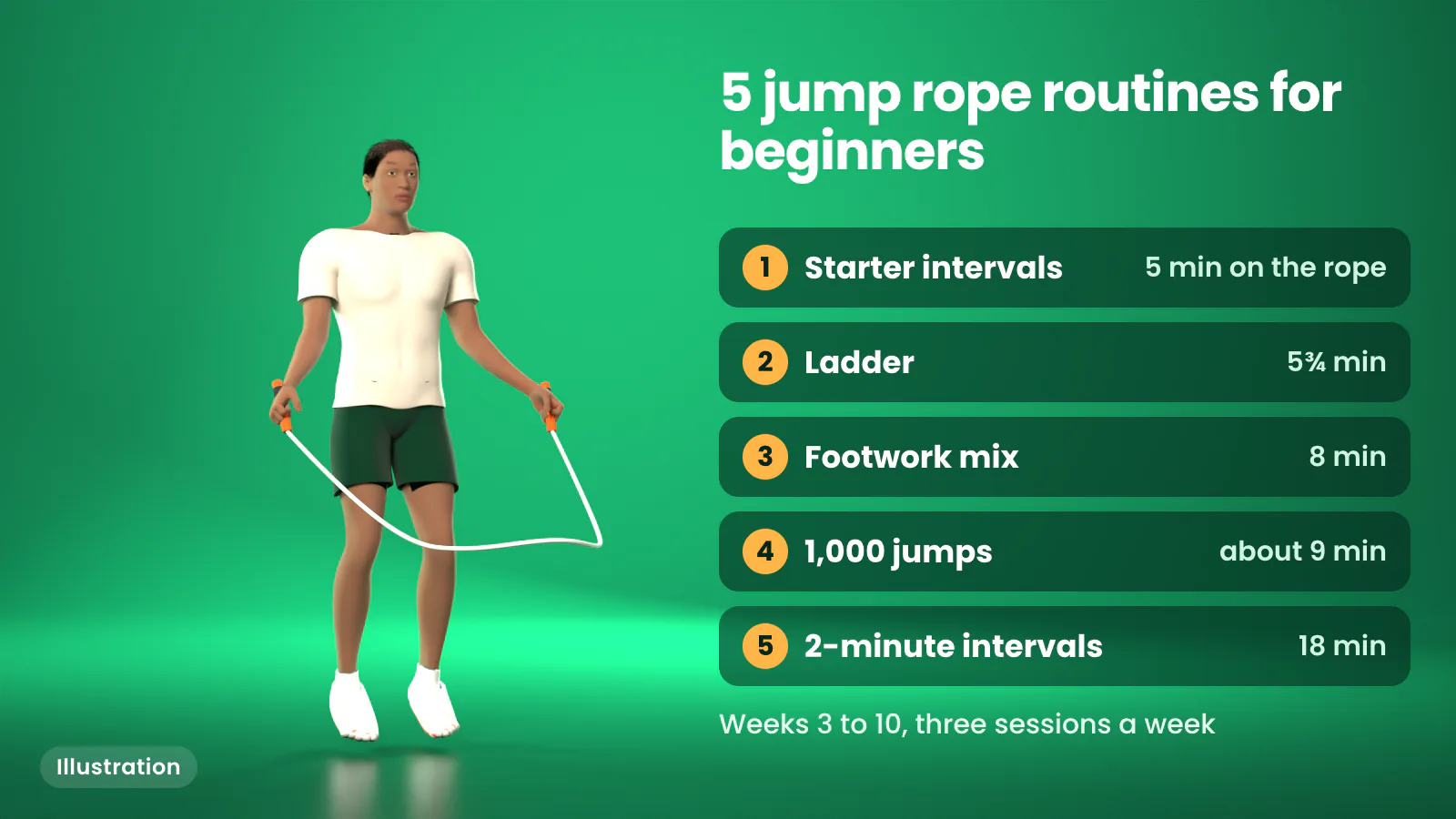
Day 30 is the same 1,000 jumps as routine 4 in our beginner routines. From there, the next step is routine 5, the 2-minute intervals from a 2025 trial, three times a week.
Count every day
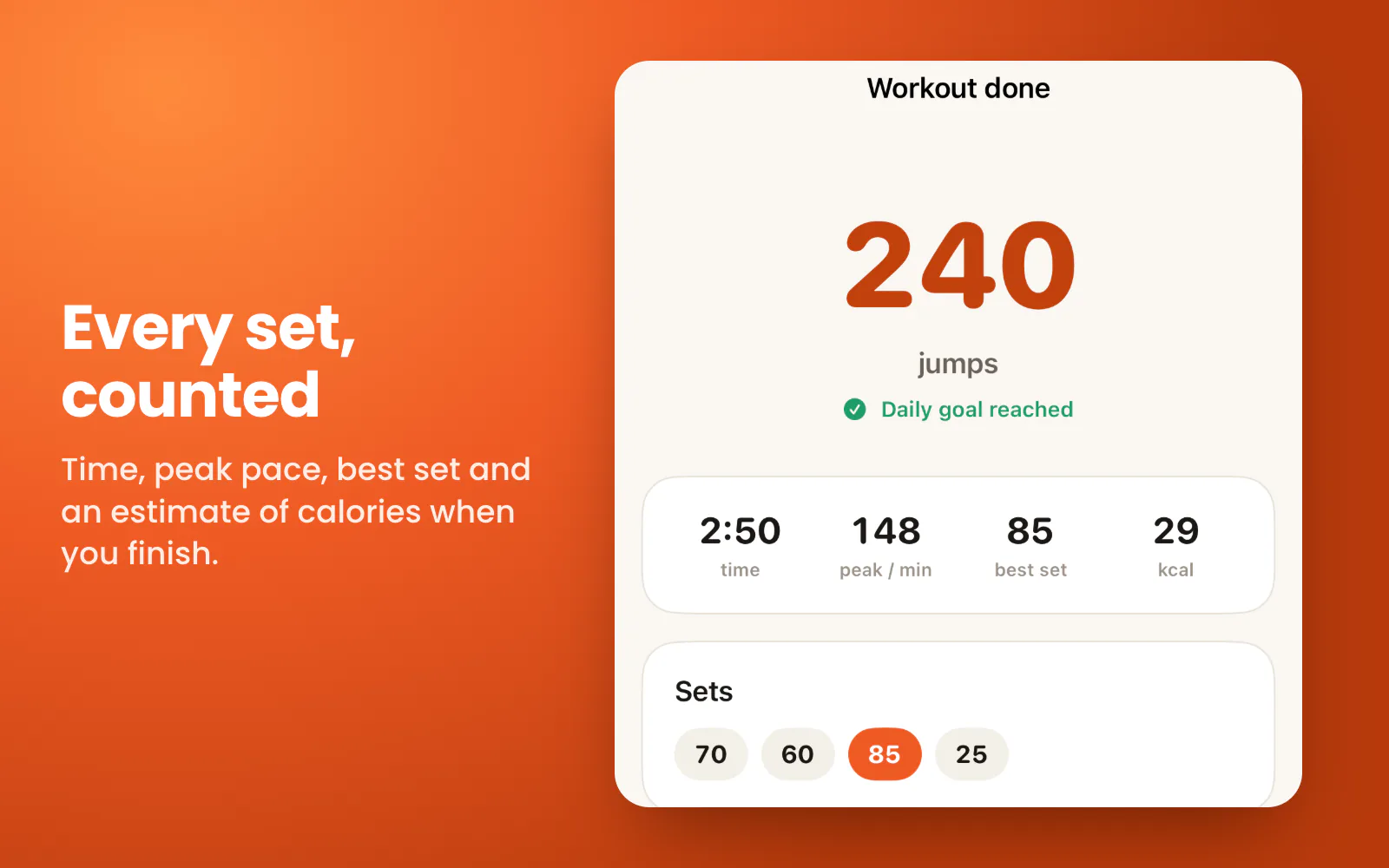
A challenge measured in jumps needs a count you don't have to keep in your head. SkipCount counts with the iPhone camera while you jump, says the count out loud, and shows each set and your total when you finish. Your first 3 workouts are free. Goal mode, which tells you when you reach the day's number, and the month calendar of the days you jumped are part of SkipCount Pro.
Download SkipCount and count day 1.
Questions
Can I jump rope every day for 30 days?+
You can, but this plan doesn't. The trials we cite trained 3 to 5 times a week, and in a 1986 trial the rope group had more injuries than the joggers. A rest day after every three jumping days gives your calves and shins time to adapt.
What results can I expect after 30 days of jump rope?+
Mostly skill: longer unbroken sets and fewer misses. Fitness gains in the trials took 6 to 8 weeks. The whole plan burns about 1,600 kcal at 70 kg, roughly 0.2 kg by the old 7,700 kcal rule, so a change on the scale in one month comes mostly from food.
How many jumps a day should a jump rope challenge use?+
This one starts at 100 and ends at 1,000. That is about 9 minutes at 110 jumps a minute, the amount one 8-week weight trial used four times a week.
What if I miss a day of the challenge?+
Pick up at the day you missed, not at today's date. The challenge is 23 sessions; if it takes you 32 or 35 days, that is fine.
Is a 30-day jump rope challenge OK for complete beginners?+
Only if you can already do the basic bounce for 20 to 30 seconds. If not, spend two weeks on our beginner guide first, then start at day 1.
Sources
- Buyze MT, et al. Comparative training responses to rope skipping and jogging. Phys Sportsmed, 1986 (checked 2026-11-06)
- Lin Z, et al. Comparison of diet and exercise on cardiometabolic factors in young adults with overweight/obesity. MedComm, 2025 (checked 2026-11-05)
- Phongchin W, et al. Effects of high-intensity interval rope-skipping on cardiorespiratory fitness, body composition, and enjoyment in young adults. Eur J Clin Nutr, 2025 (checked 2026-11-09)
- Hall KD, et al. Quantification of the effect of energy imbalance on bodyweight. Lancet, 2011 (checked 2026-11-05)
- 2024 Adult Compendium of Physical Activities: Sports (rope jumping, codes 15550 to 15552) (checked 2026-11-03)