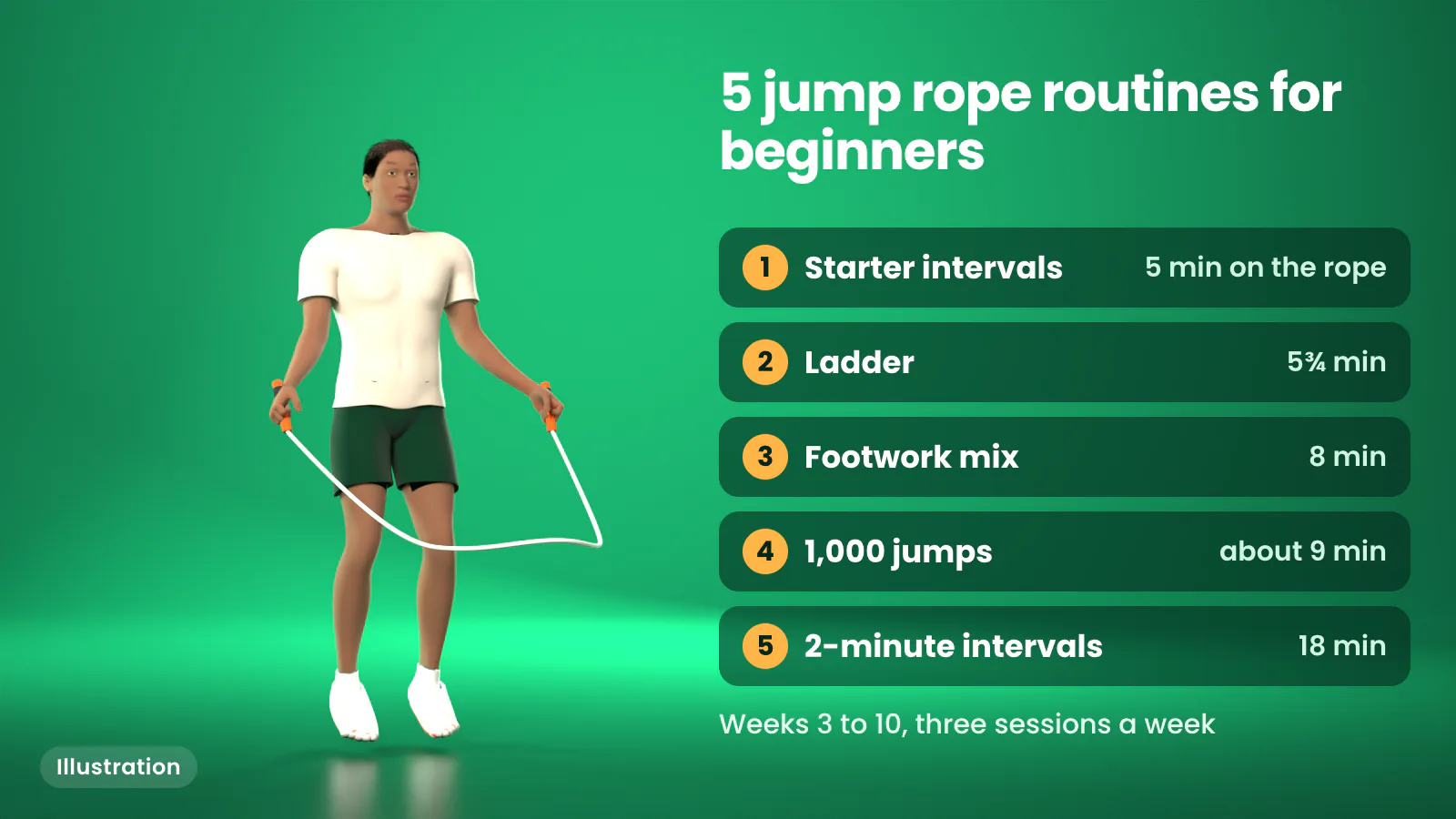
5 jump rope routines for beginners, from 5 to 18 minutes on the rope
 By Rupangkan KalitaUpdated
Once you can do the basic bounce, follow these in order, three times a week: 10 × 30-second intervals, a 30-to-75-second ladder, a three-move footwork mix, 1,000 jumps in sets of 100, then nine 2-minute intervals. That takes you from 5 to 18 minutes on the rope by about week 10.
Most jump rope workouts online are built for people who can already skip for five minutes straight. These five are not. They pick up where our beginner guide stops, after two weeks of 20- and 30-second sets, and take you to about 18 minutes on the rope by week 10.
The routines and the week numbers are our suggestion. Two of them copy what was used in published trials, and we say which.
Before you start
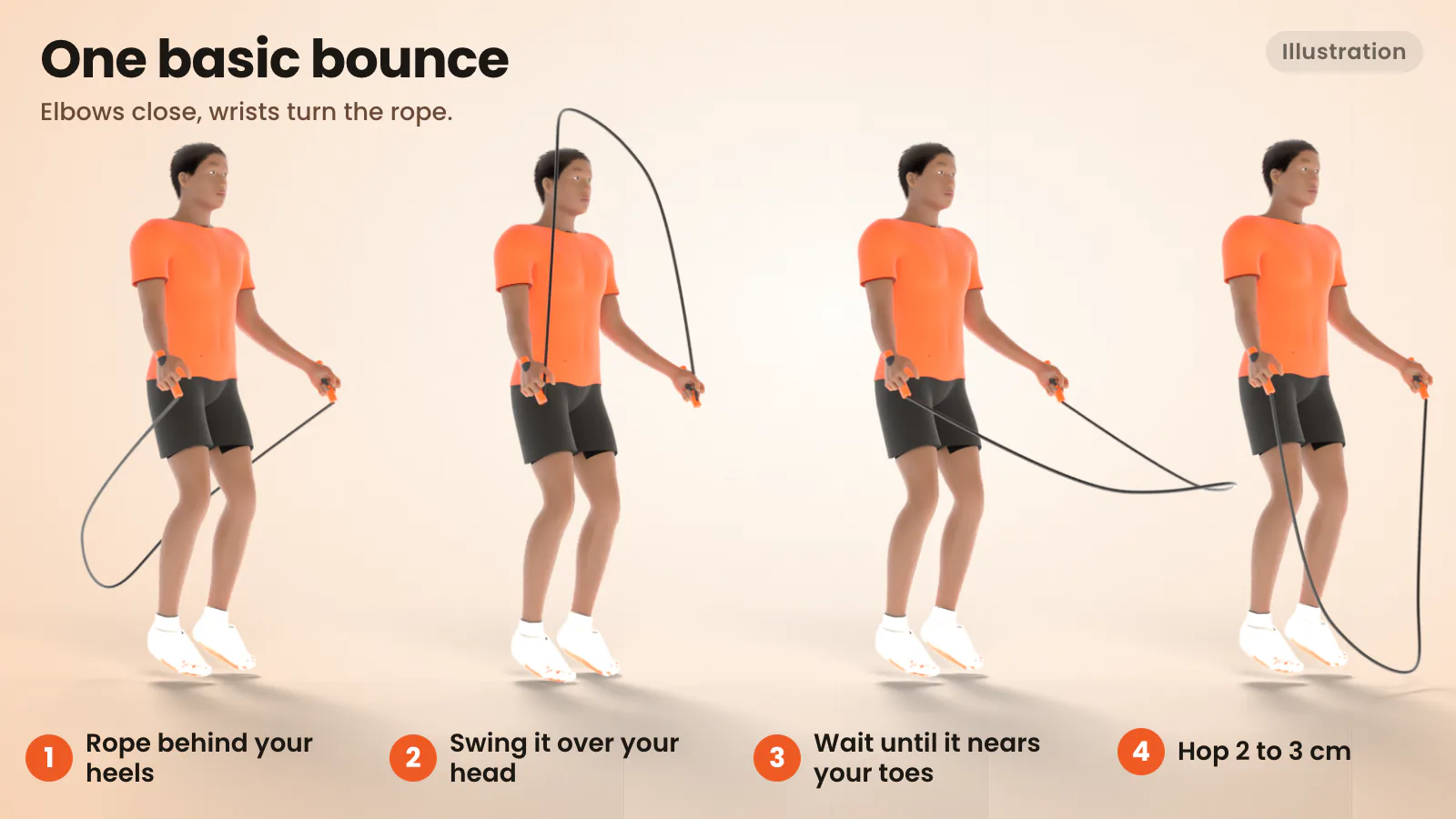
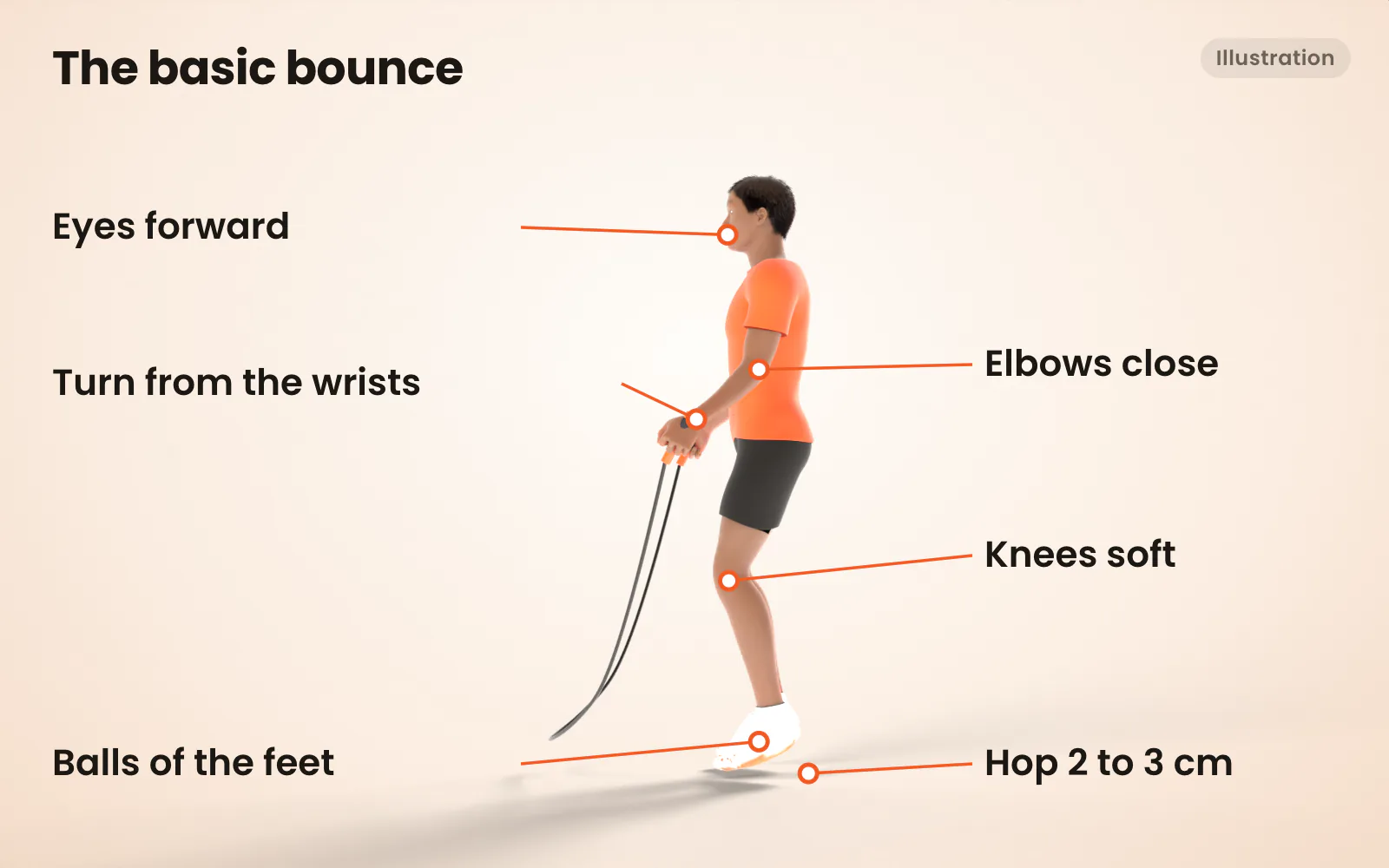
- You can do the basic bounce: both feet together, a small 2 to 3 cm hop, turning from the wrists. If not, start with the beginner guide.
- Three sessions a week, with a day off between them.
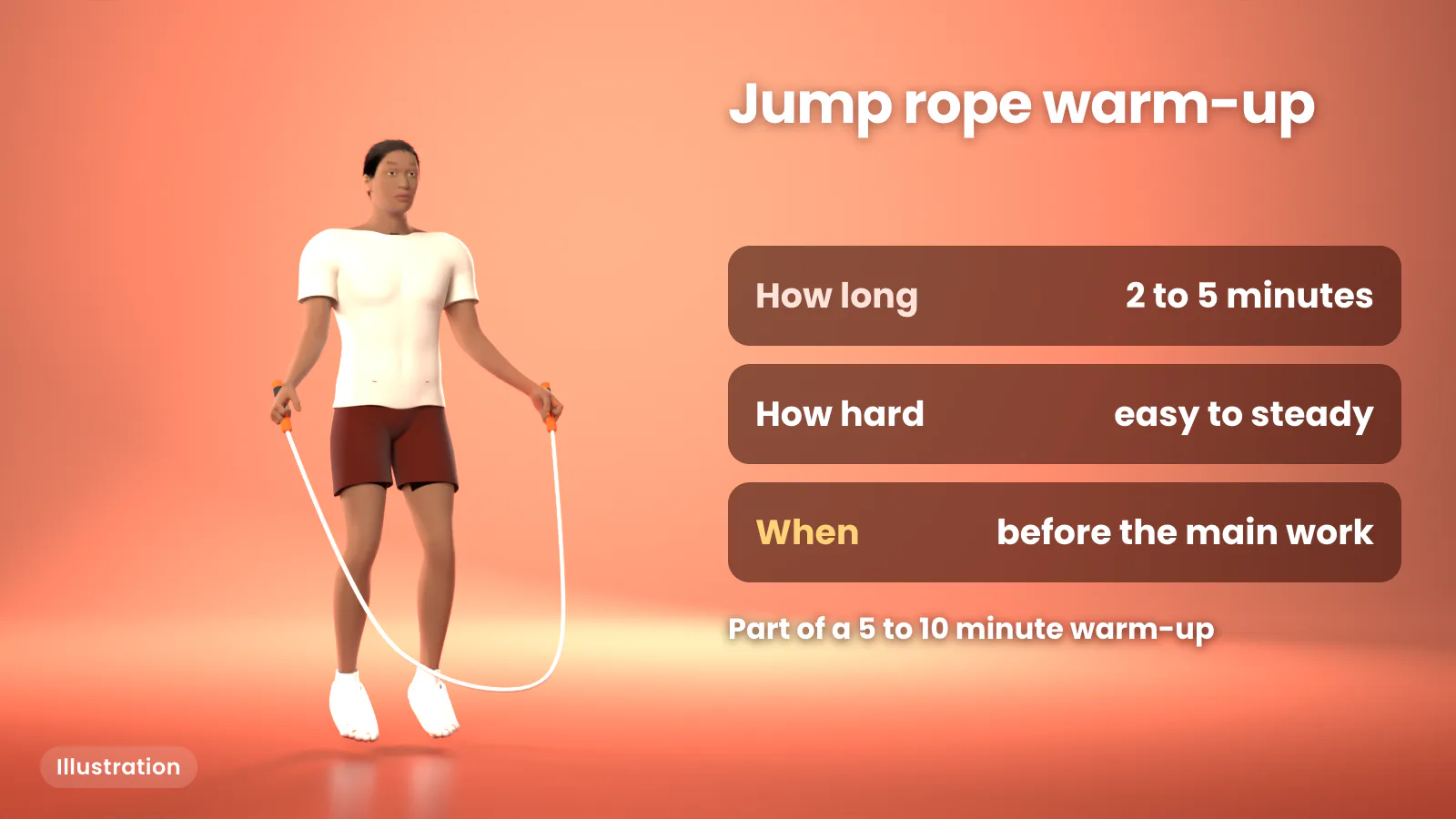
- Warm up for 2 to 3 minutes: march on the spot, then an easy bounce without the rope.
- All times are time with the rope turning. A trip and restart still counts as the same set.
The five routines at a glance
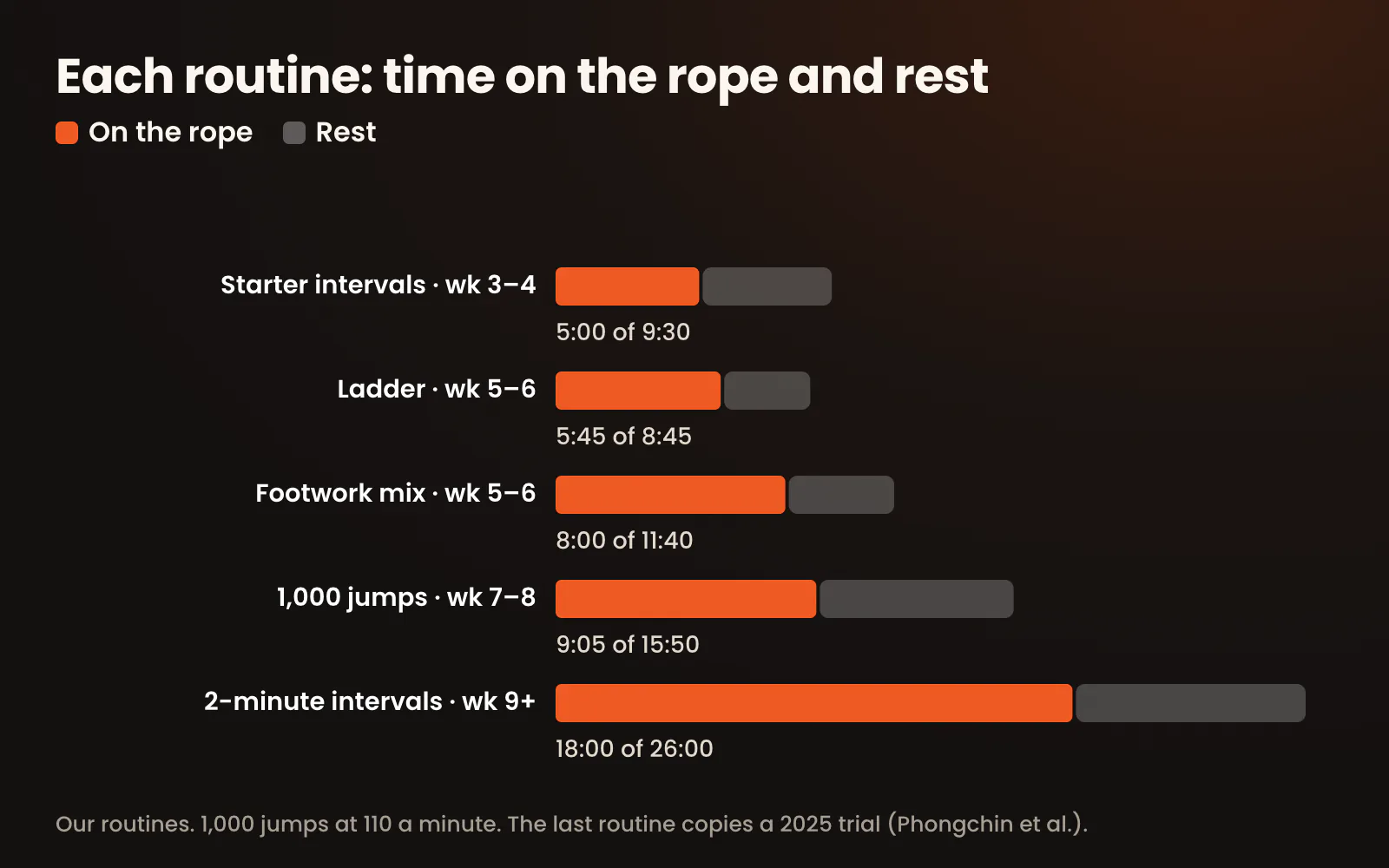
| Routine | Weeks | Work | Rest | On the rope | Total |
|---|---|---|---|---|---|
| 1. Starter intervals | 3 to 4 | 10 × 30 seconds | 30 seconds | 5:00 | 9:30 |
| 2. Ladder | 5 to 6 | 30, 45, 60, 75, 60, 45, 30 seconds | 30 seconds | 5:45 | 8:45 |
| 3. Footwork mix | 5 to 6 | 4 rounds of 3 moves × 40 seconds | 20 seconds | 8:00 | 11:40 |
| 4. 1,000 jumps | 7 to 8 | 10 × 100 jumps | 45 seconds | about 9:05 | about 15:50 |
| 5. 2-minute intervals | 9 and on | 9 × 2 minutes | 1 minute, easy | 18:00 | 26:00 |
In weeks 5 and 6, alternate routines 2 and 3.
1. Starter intervals (weeks 3 and 4)
Ten rounds of 30 seconds on, 30 seconds off, all basic bounce. It is the second week of the beginner plan done 10 times instead of 8. If you trip, pick the rope back up and keep the clock running.
Aim: finish all 10 rounds. Your jump rate does not matter yet.
2. Ladder (weeks 5 and 6)
Jump 30, 45, 60, 75, 60, 45 and 30 seconds, with 30 seconds of rest after each. The 75-second set in the middle is the point of it: your first set longer than a minute.
If 75 seconds falls apart, cap the top at 60 and try again next session.
3. Footwork mix (weeks 5 and 6)
Four rounds of three moves, 40 seconds each, with 20 seconds of rest after every move:
- Basic bounce.
- Alternate-foot step: a light jog on the spot, one foot over the rope at a time. In a 1988 study of experienced jumpers it was the most energy-efficient of five techniques, which makes it the move that lets you go longer later.
- Side to side: the basic bounce, landing a few centimetres left, then right.
The point is variety and coordination, not speed. Go back to the basic bounce for any move you can't hold for 40 seconds.
4. 1,000 jumps (weeks 7 and 8)
Ten sets of 100 jumps with 45 seconds of rest. At 110 jumps a minute, each set takes about 55 seconds. This one runs on a count, not a clock.
A 2025 trial in young adults with overweight or obesity used 1,000 jumps, four sessions a week, for 8 weeks; our weight loss article has the results. We keep it at three sessions here because you are still building up.
5. 2-minute intervals (week 9 and on)
Nine rounds of 2 minutes on the rope with 1 minute of easy recovery (walk or march on the spot). This is the interval session from a 2025 trial in 59 healthy young adults: three times a week for 8 weeks, at about 80% of maximum heart rate. Their VO2max rose from 43.8 to 48.4 mL/kg/min. Our cardio article has the details.
At 18 minutes on the rope, three sessions make 54 minutes a week. Add a fourth session or a few extra minutes to reach the WHO minimum of 75 vigorous minutes; see how long to jump rope a day.
When to move up, and when to repeat
Our rule of thumb:
- Move up when you finish every set with no more than two misses, and can still say a few words between sets. The CDC describes vigorous effort as only being able to say a few words before pausing for breath.
- Repeat the week if you can't finish the sets, or your calves are still sore two days later.
- Back off one routine after a week or more off.
Jump rope is vigorous at every pace: the Compendium lists 8.3 METs for a slow pace under 100 skips a minute. You don't need to speed up to make these harder. Longer sets do that.
If you have joint, heart or other health problems, or have not exercised in a long time, check with your doctor first.
Count it so you can see it
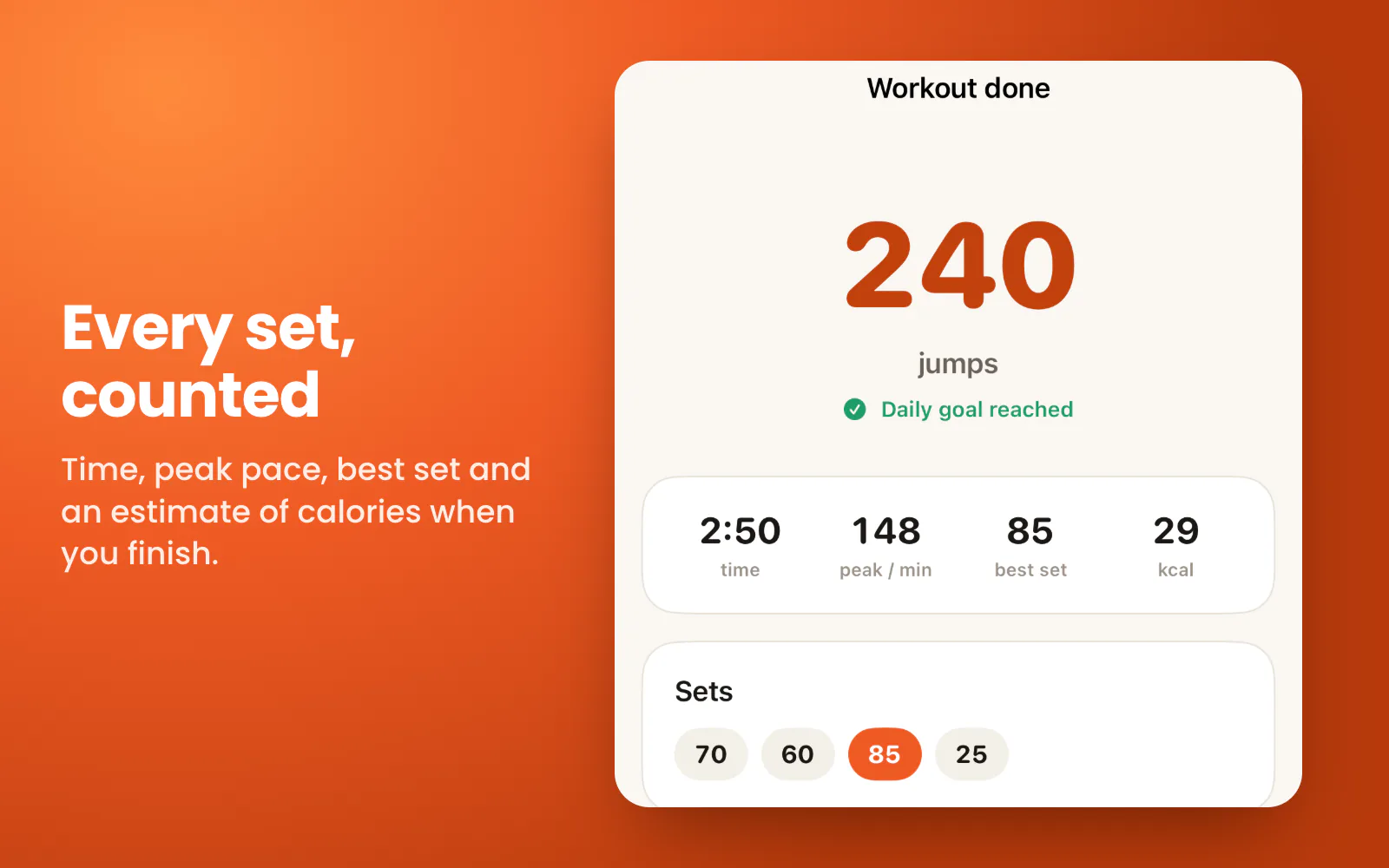
Routine 4 runs on a count, and the "move up" rule depends on knowing your sets. SkipCount counts with the iPhone camera while you jump, says the count out loud, and when you finish shows the jumps in every set, your best set and your time. Your first 3 workouts are free; after that, counting and the timer and goal modes are part of SkipCount Pro.
Download SkipCount and run your first routine with every jump counted.
Questions
What is a good jump rope routine for beginners?+
Short intervals: 30 seconds of the basic bounce, 30 seconds of rest, 10 times. That is 5 minutes on the rope in under 10 minutes. Do it three times a week, then move on to longer sets.
How many times a week should a beginner jump rope?+
Three, with a day off in between. The rope studies we cite trained 3 to 5 times a week, and your calves and feet need time to adapt at first.
Is a 10-minute jump rope workout enough?+
For a beginner, yes. The starter routine fits in 10 minutes with 5 of them on the rope. A 1986 trial found 10 minutes on the rope, five times a week, raised fitness in 6 weeks.
When should I move to the next routine?+
Our rule: when you finish every set with no more than two misses and can still say a few words between sets, move up. If not, repeat the week. Missing a week is fine; drop back one routine.
Do I need to count jumps?+
Only the 1,000-jump routine runs on a count; the others use a timer. Counting still helps, because your longest unbroken set is the clearest sign of progress in the first months.
Sources
- Phongchin W, et al. Effects of high-intensity interval rope-skipping on cardiorespiratory fitness, body composition, and enjoyment in young adults. Eur J Clin Nutr, 2025 (checked 2026-11-09)
- Lin Z, et al. Comparison of diet and exercise on cardiometabolic factors in young adults with overweight/obesity. MedComm, 2025 (checked 2026-11-05)
- Buyze MT, et al. Comparative training responses to rope skipping and jogging. Phys Sportsmed, 1986 (checked 2026-11-06)
- Solis K, et al. Aerobic requirements for and heart rate responses to variations in rope jumping techniques. Phys Sportsmed, 1988 (checked 2026-11-09)
- CDC: Measuring physical activity intensity (checked 2026-11-08)
- 2024 Adult Compendium of Physical Activities: Sports (rope jumping, codes 15550 to 15552) (checked 2026-11-03)