Jump rope benefits: what the research shows and where it falls short
 By Rupangkan KalitaPublished
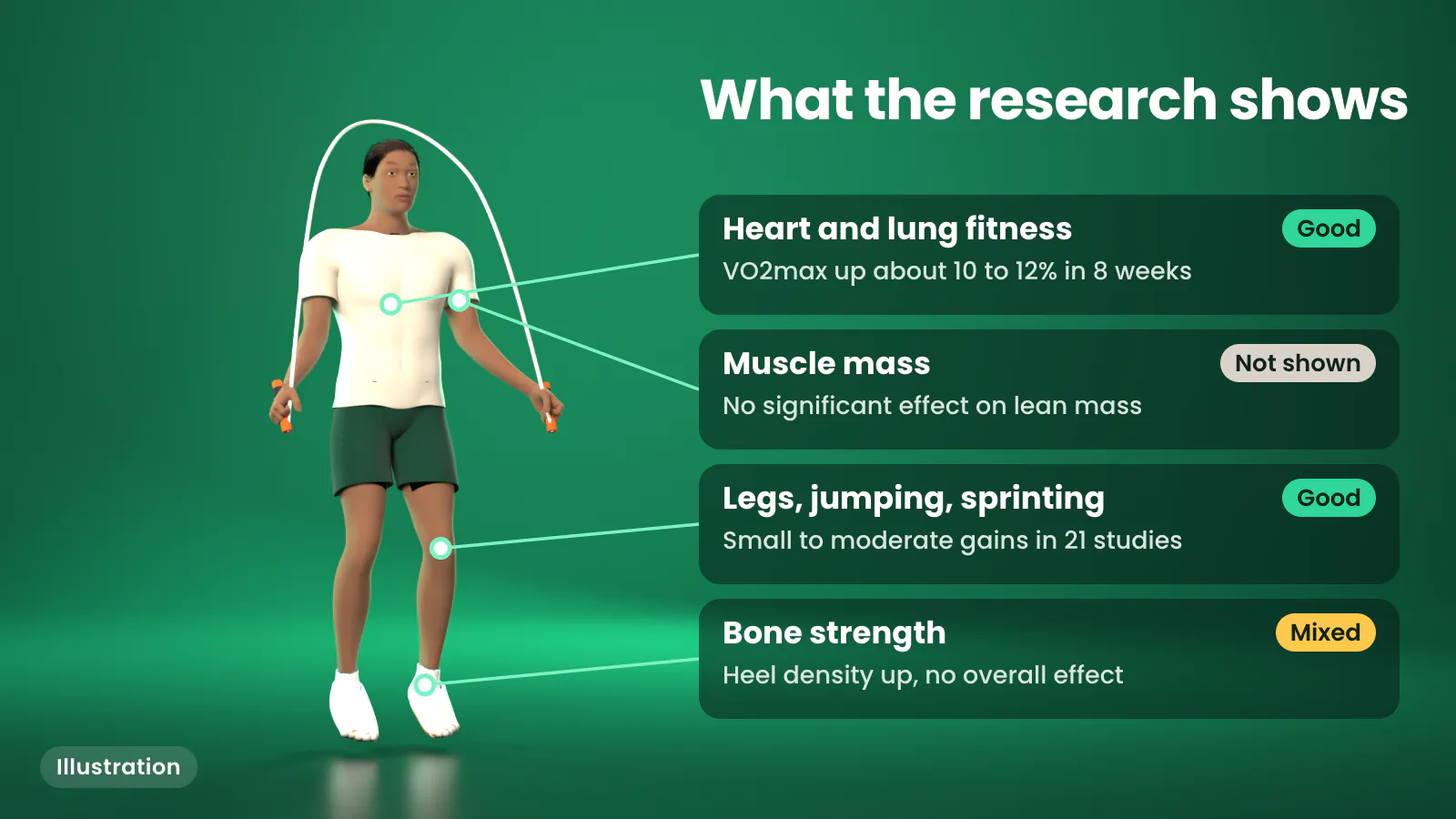
Jump rope clearly improves fitness: in an 8-week trial of young adults, VO2max rose about 10 to 12%, and a review of 21 studies found small to moderate gains in resting heart rate, body fat, strength, jumping and sprinting. Evidence for bone and blood pressure is mixed, it did not add lean mass, and 10 minutes did not match 30 minutes of jogging.
Most lists of jump rope benefits repeat the same claims with no numbers. We read the published trials instead. Jump rope does improve fitness, and some of the popular claims hold up. Others are weaker than they sound, and most of the research was done on children and young adults.
The evidence at a glance
The ratings are our own reading of these studies, not a formal grade.
| Benefit | What studies found | Who was tested | Our rating |
|---|---|---|---|
| Heart and lung fitness | VO2max up about 10 to 12% in 8 weeks | 59 healthy young adults | Good |
| Resting heart rate and body fat | Small to moderate gains across 21 studies | 1,021 people, mostly under 18 | Good, mainly in young people |
| Leg strength, jumping, sprinting | Small to moderate gains across the same 21 studies | 1,021 people, mostly under 18 | Good, mainly in young people |
| Running speed | Faster 3 km time trial after 10 weeks | 96 amateur runners | Promising, one large trial |
| Balance and coordination | 9% faster on a motor skills circuit, plus gains across 15 trials | Children, mostly 10 to 12 | Good in children |
| Bone strength | Higher heel bone density, no overall effect in the review | Mostly teenage girls | Mixed |
| Blood pressure | Systolic down from 126 to 120 mmHg in one trial, no overall effect in the review | 40 girls with prehypertension | Mixed |
| Weight loss | 0.6 to 1.5 kg in 8 weeks | University students | Modest, see the weight loss guide |
| Muscle mass | No significant effect on lean mass | 1,021 people, mostly under 18 | Not shown |
Heart and lung fitness
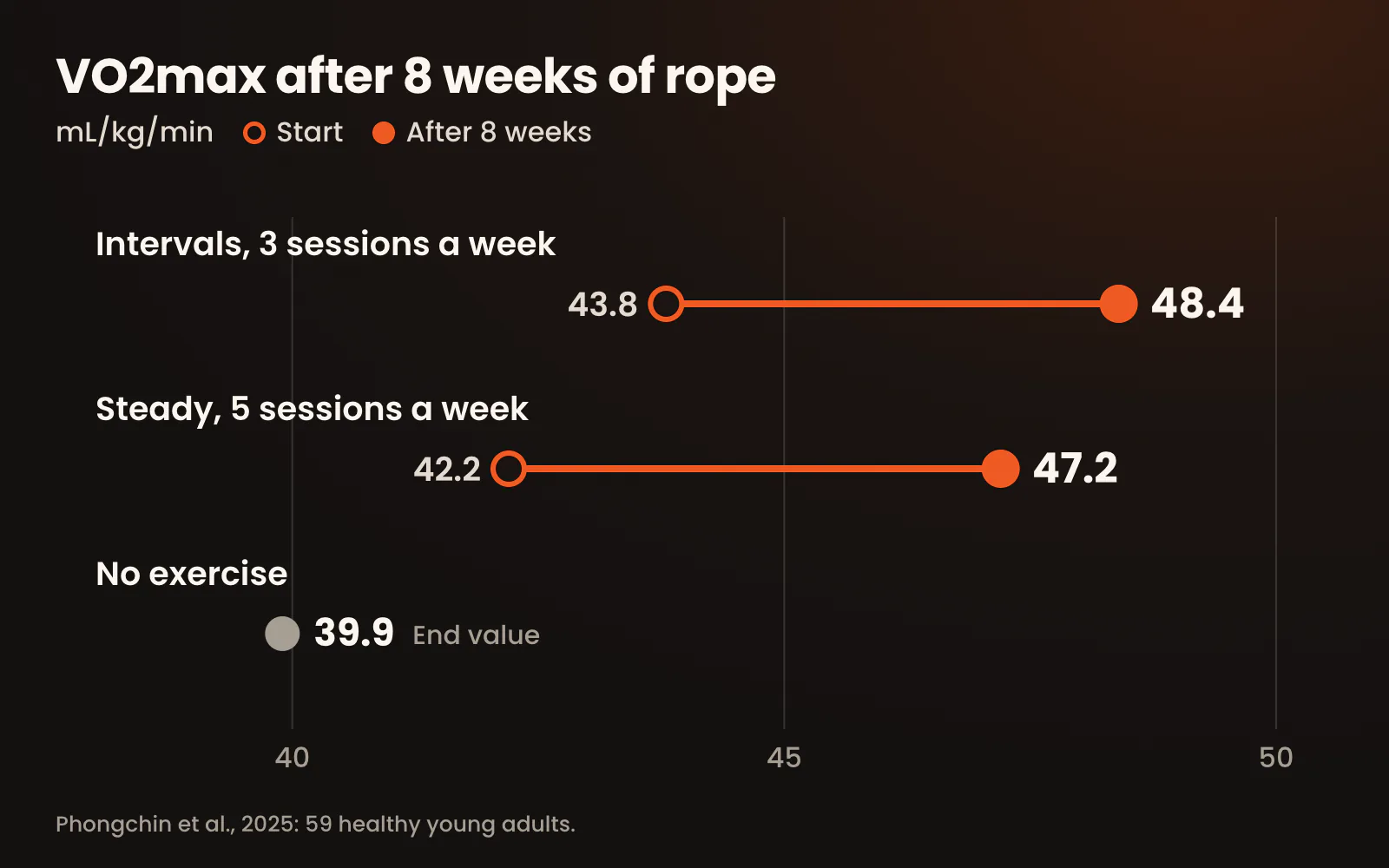
This is the strongest benefit, and it has been tested in adults. In a 2025 trial, 59 healthy adults averaging about 22 years old were assigned to one of two rope plans or no exercise for 8 weeks.
- Intervals, 3 sessions a week: nine 2-minute bouts at 80% of maximum heart rate, with 1 minute of active recovery. VO2max rose from 43.8 to 48.4 mL/kg/min.
- Steady, 5 sessions a week: 30 minutes at 70% of maximum heart rate. VO2max rose from 42.2 to 47.2 mL/kg/min.
Both plans beat the control group, which ended at 39.9, and people enjoyed them equally. The interval plan got a similar result with far less rope time. Body composition did not change in any group, so fitness can improve before the mirror shows it.
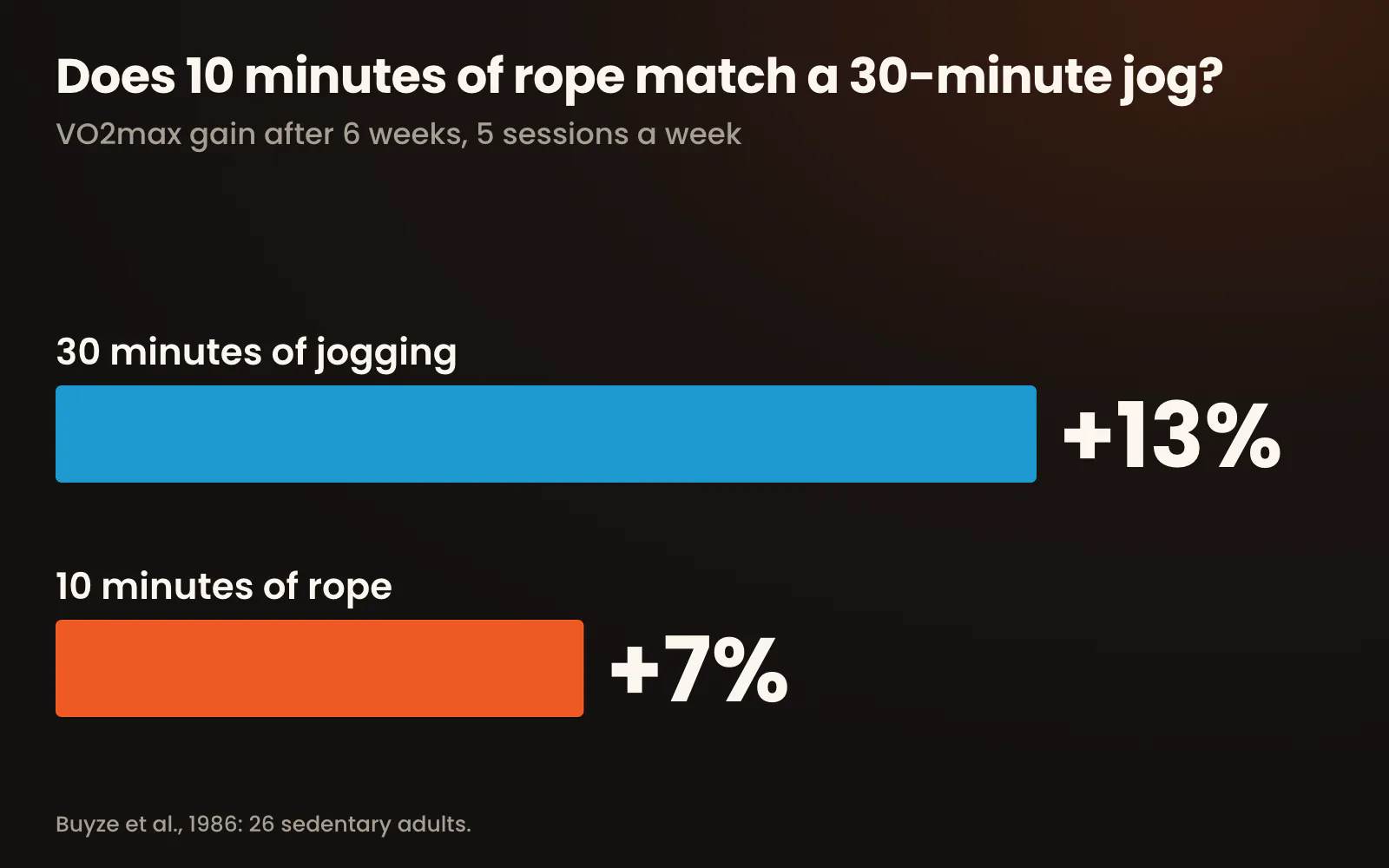
Does 10 minutes equal 30 minutes of jogging?
You will see this claim often, and it was tested directly. In a 1986 trial, 26 sedentary adults trained five times a week for six weeks. VO2max rose 13% in the group jogging for 30 minutes and 7% in the group skipping for 10 minutes. The researchers concluded that 10 minutes of rope did not match 30 minutes of jogging, and the rope group had more injuries and drop-outs.
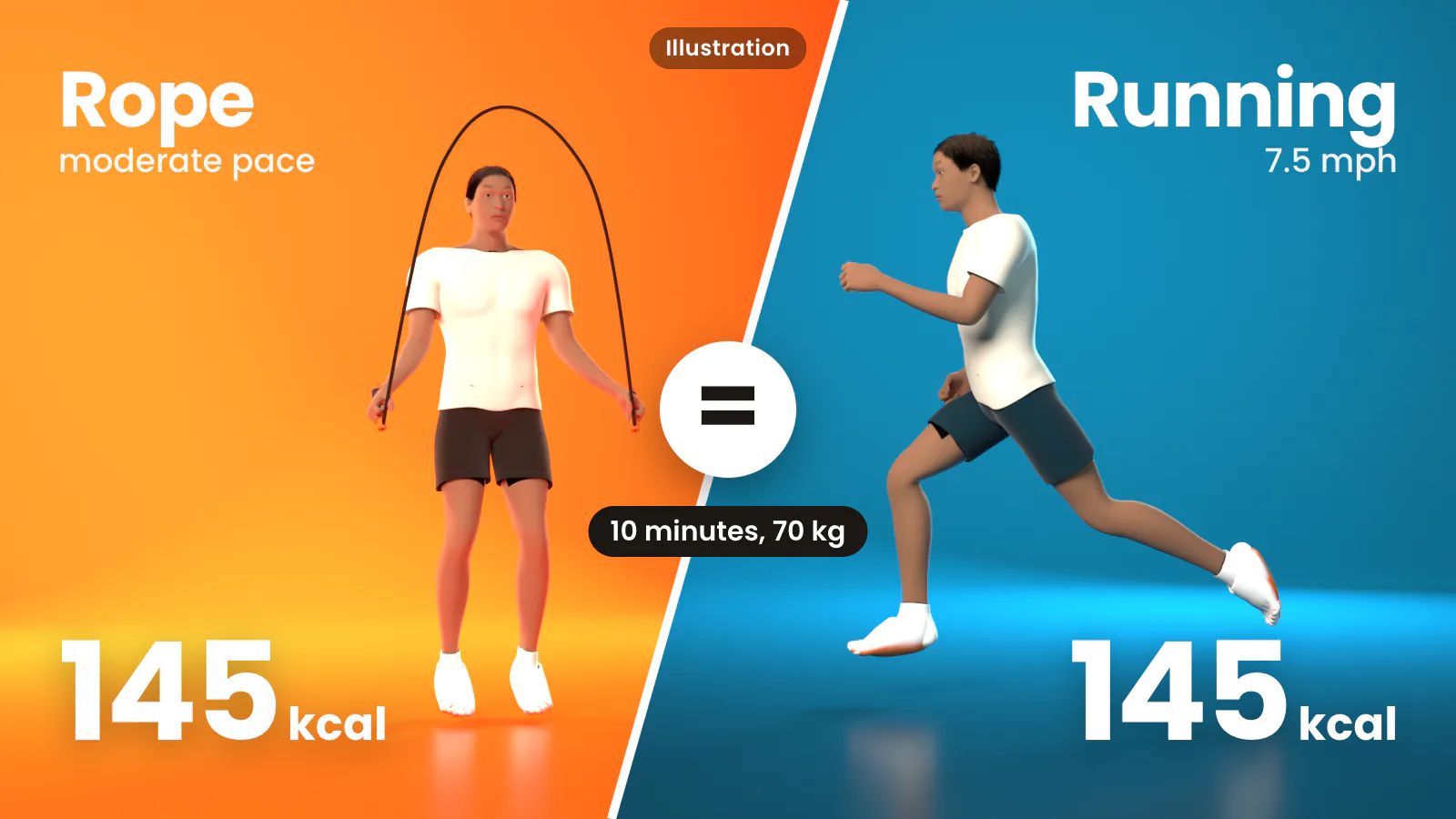
A 2025 trial of 92 college students in China also favoured jogging for short-term fitness scores. Minute for minute the two are close in intensity, but rope time does not count triple. The jump rope vs running comparison has the numbers by pace.
Legs, speed and running
A 2022 review pooled 21 studies with 1,021 participants, 18 of them with an average age under 18. Compared with control groups, rope training improved maximal strength in the lower and upper body, jumping, sprinting and range of motion by a small to moderate amount.
Adult runners benefit too. In a 2020 trial, 96 amateur runners either kept their routine or swapped 5 minutes of their warm-up for rope jumping, 2 to 4 sessions and 10 to 20 minutes a week in total. After 10 weeks the rope group improved their 3 km time trial, jump tests and foot arch stiffness, and the control group did not change.
Those authors describe rope jumping as working mainly the foot muscles and joints, through the quick rebounds. Expect your calves and feet to feel it first. It is poor at adding size: the same review found no significant effect on lean mass or muscle endurance.
Balance and coordination
Most of this evidence comes from children. In a 2015 study of 24 young soccer players, adding rope exercises for 8 weeks cut their time on a motor skills circuit by 9% and improved balance, while the control group's circuit time did not change. A 2023 review of 15 trials and 1,048 children aged 10 to 12 found benefits over regular physical education, with coordination and balance improving most in girls and speed, strength and agility most in boys. It found no advantage for body shape.
Bones and blood pressure
Jumping loads bone, so a benefit makes sense, but results vary.
- For: 176 Hong Kong girls who skipped weekly had higher heel bone density than those who did not, though forearm density did not differ. In a 2002 trial, high school girls jumping 10 minutes a session had stiffer heel bones than controls after 4 months.
- Against: the 2022 review found no significant effect on bone mass overall. In a 12-week school program, bone density rose only in the group doing freestyle rope skills, not in the group doing traditional jump rope.
Blood pressure splits the same way. In 40 teenage girls with prehypertension, 12 weeks of rope exercise lowered systolic pressure from 126 to 120 mmHg and improved arterial stiffness. The 2022 review found no significant effect on blood pressure overall.
None of these studies tested older adults, so do not use a rope as a treatment.
The downsides
Impact. Landings add up, and the 1986 trial's rope group had more injuries and drop-outs than the joggers. Going from nothing to daily long sessions is the mistake to avoid.
Knees. The basic step looks gentler than people expect. In a lab study of 22 healthy women aged 18 to 25 at 105 skips a minute, landing force and hip and knee loading were lower than in running and higher than in walking. Advanced skills differ: in 16 competitive teenagers doing double unders and speed steps, peak force was similar to running and ankle braking power was 39 to 114% greater. These are lab measurements. Our PubMed search on 6 November 2026 found no long-term study of knee health in rope jumpers.
Technique and shoes. In 16 teenage boys, a two-foot bounce gave lower peak force and loading rate than an alternating foot step. Among 14 experienced jumpers, shoes lowered the peak loading rate compared with bare feet.
Bladder leaks. In a survey at a national competition, 67 of 89 female athletes reported leaking during jumps, mostly in double and triple unders. That is a competitive group, not casual jumpers, but if it happens to you, a doctor or pelvic floor physiotherapist can help.
If you have osteoporosis, a joint or heart condition, or are coming back from an injury, ask your doctor first. Stop if something hurts.
How much did the studies use?
These are the amounts behind the results above.
| Goal | What the study used | Length |
|---|---|---|
| Fitness, short on time | Nine 2-minute bouts at 80% of maximum heart rate, 1 minute easy between, 3 a week | 8 weeks |
| Fitness, steady pace | 30 minutes at 70% of maximum heart rate, 5 a week | 8 weeks |
| Faster running | 10 to 20 minutes a week, replacing part of the warm-up | 10 weeks |
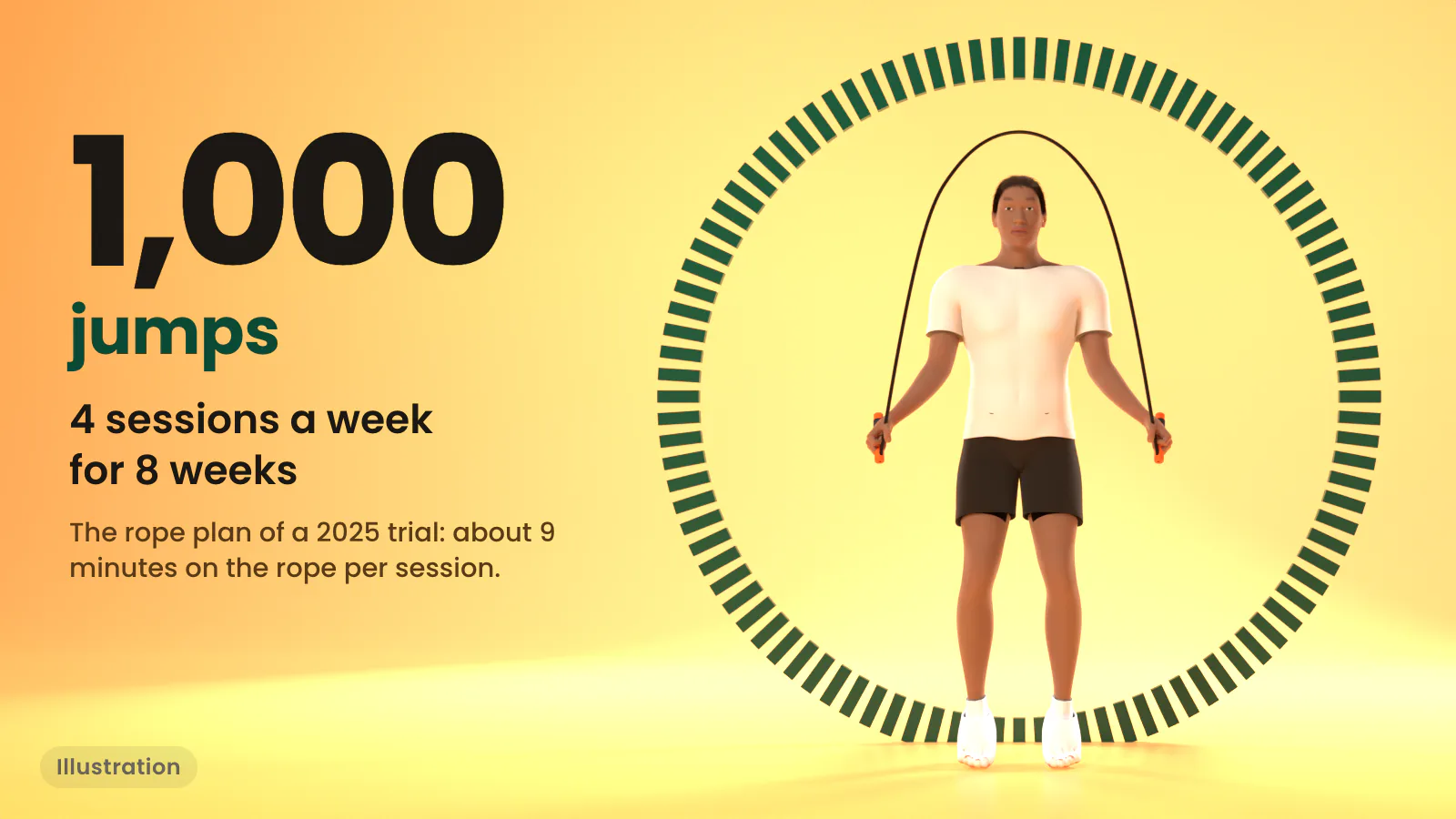
| Weight loss | 1,000 jumps, 4 a week | 8 weeks |
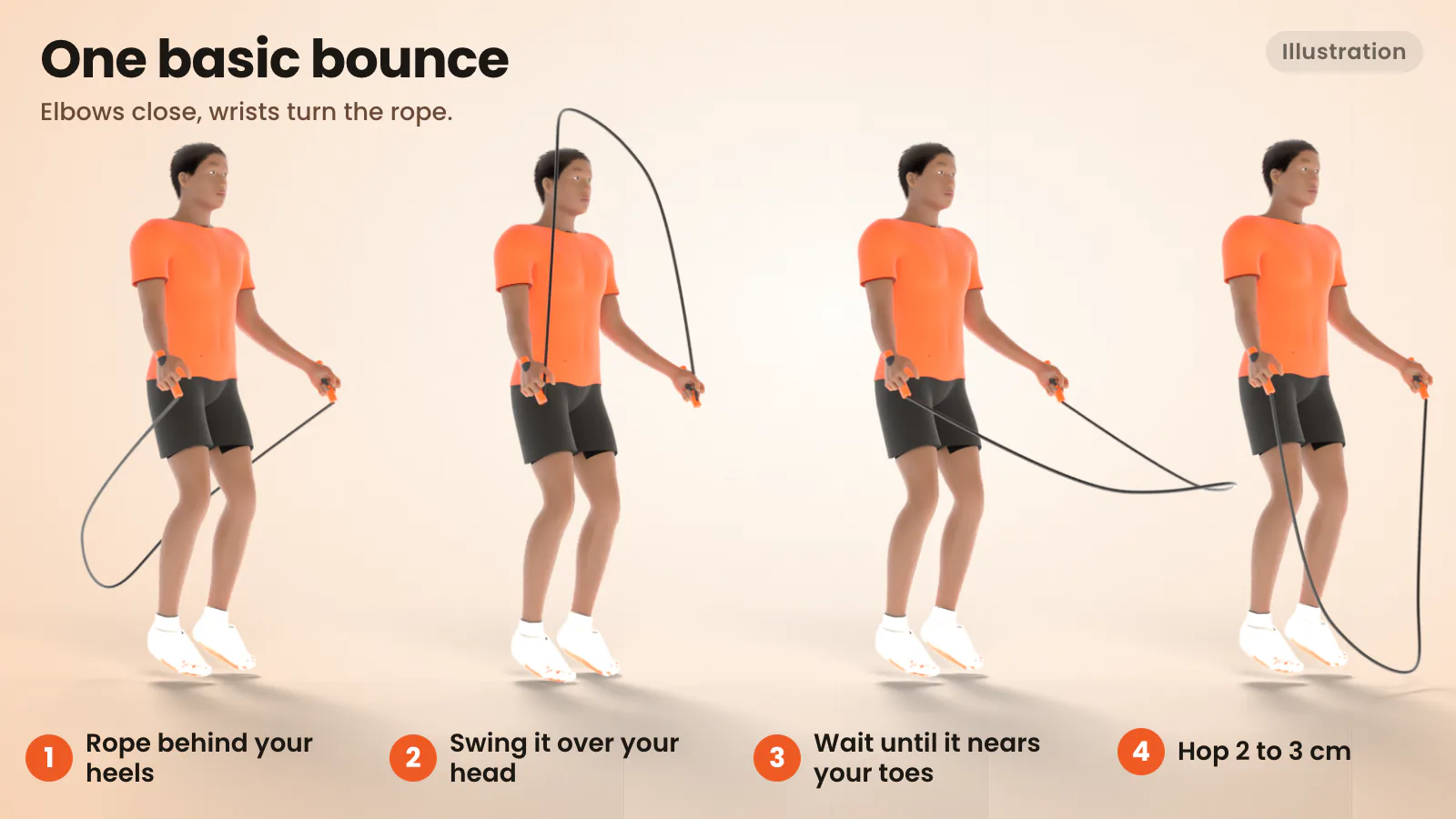
Two-minute bouts are a long way from day one for most people. Start with the short sets in the beginner guide and work towards these.
Know what you actually did
Every plan above is measured in jumps, bouts or minutes, so it helps to have the number. SkipCount counts for you: prop your iPhone up, step back and jump. The camera counts each jump, says the count out loud and shows your tempo and each set's total. Just jump mode is free and unlimited, and timed sessions are part of Pro.
Download SkipCount and count your next session.
Questions
What are the main benefits of jumping rope?+
The best supported are better heart and lung fitness, a lower resting heart rate, less body fat, and stronger, faster legs. A 2022 review of 21 studies found small to moderate gains in these, though most participants were under 18. Children also improved balance and coordination in several trials.
Is jumping rope good for your heart?+
For fitness, yes. In a 2025 trial, young adults raised their VO2max by about 10 to 12% in 8 weeks. Blood pressure is less clear: one trial of 40 girls with prehypertension saw systolic pressure fall from 126 to 120 mmHg, but a review of 21 studies found no significant overall effect.
Is 10 minutes of jump rope equal to 30 minutes of jogging?+
It did not hold up when tested. In a 1986 trial, sedentary adults trained five times a week for six weeks. VO2max rose 13% with 30 minutes of jogging and 7% with 10 minutes of rope skipping, and the rope group had more injuries and drop-outs.
Does jump rope build muscle?+
Not much. A review of 21 studies found gains in maximal strength and jumping, but no significant effect on lean mass or muscle endurance. It trains your lower legs and feet hard, so treat it as conditioning and use resistance training if adding muscle is the goal.
Is jump rope bad for your knees?+
The basic bounce step looks gentler than running. In a lab study of 22 healthy young women, landing force and hip and knee loading were lower than in running and higher than in walking. Advanced skills are harder on the legs, and our PubMed search found no long-term study of knee health in rope jumpers.
How long should I jump rope each day?+
No daily number is proven. Trials that worked used about 10 to 20 minutes a week as part of a runner's warm-up, or three sessions a week of nine 2-minute bouts. If you are new, start with short sets and build up over several weeks.
Sources
- Phongchin W, et al. Effects of high-intensity interval rope-skipping on cardiorespiratory fitness, body composition, and enjoyment in young adults. Eur J Clin Nutr, 2025 (checked 2026-11-06)
- Singh U, et al. Jump rope training effects on health- and sport-related physical fitness in young participants: a systematic review with meta-analysis. J Sports Sci, 2022 (checked 2026-11-06)
- Zhao Q, et al. Jumping rope improves the physical fitness of preadolescents aged 10-12 years: a meta-analysis. J Sports Sci Med, 2023 (checked 2026-11-06)
- Buyze MT, et al. Comparative training responses to rope skipping and jogging. Phys Sportsmed, 1986 (checked 2026-11-06)
- Chen Y, et al. Differential impacts of jogging and rope skipping in college students in China. Front Public Health, 2025 (checked 2026-11-06)
- García-Pinillos F, et al. Jump-rope training: improved 3-km time-trial performance in endurance runners. Int J Sports Physiol Perform, 2020 (checked 2026-11-06)
- Trecroci A, et al. Jump rope training: balance and motor coordination in preadolescent soccer players. J Sports Sci Med, 2015 (checked 2026-11-06)
- Ha AS, et al. Rope skipping increases bone mineral density at calcanei of pubertal girls in Hong Kong. PLoS One, 2017 (checked 2026-11-06)
- Arnett MG, et al. Effects of rope-jump training on the os calcis stiffness index of postpubescent girls. Med Sci Sports Exerc, 2002 (checked 2026-11-06)
- Yang X, et al. Physical fitness promotion among adolescents: effects of a jump rope-based physical activity afterschool program. Children, 2020 (checked 2026-11-06)
- Sung KD, et al. The effects of a 12-week jump rope exercise program in adolescent girls with prehypertension. Eur J Appl Physiol, 2019 (checked 2026-11-06)
- Mullerpatan R, et al. Lower extremity joint loading during bounce rope skip in comparison to run and walk. J Bodyw Mov Ther, 2021 (checked 2026-11-06)
- Bruce OL, et al. Lower-limb joint kinetics in jump rope skills performed by competitive athletes. Sports Biomech, 2023 (checked 2026-11-06)
- Lin Y, et al. The influence of different rope jumping methods on adolescents' lower limb biomechanics during the ground-contact phase. Children, 2022 (checked 2026-11-06)
- Li J, et al. Effects of barefoot and shod conditions on the lower extremities in alternating jump rope skipping. Bioengineering, 2023 (checked 2026-11-06)
- Dobrowolski SL, et al. Urinary incontinence among competitive rope-skipping athletes: a cross-sectional study. Int Urogynecol J, 2020 (checked 2026-11-06)
- Lin Z, et al. Comparison of diet and exercise on cardiometabolic factors in young adults with overweight/obesity. MedComm, 2025 (checked 2026-11-05)
- Tang Z, et al. Effects of caloric restriction and rope-skipping exercise on cardiometabolic health. Nutrients, 2021 (checked 2026-11-05)