Jump rope muscles worked: what the studies measured
 By Rupangkan KalitaPublished
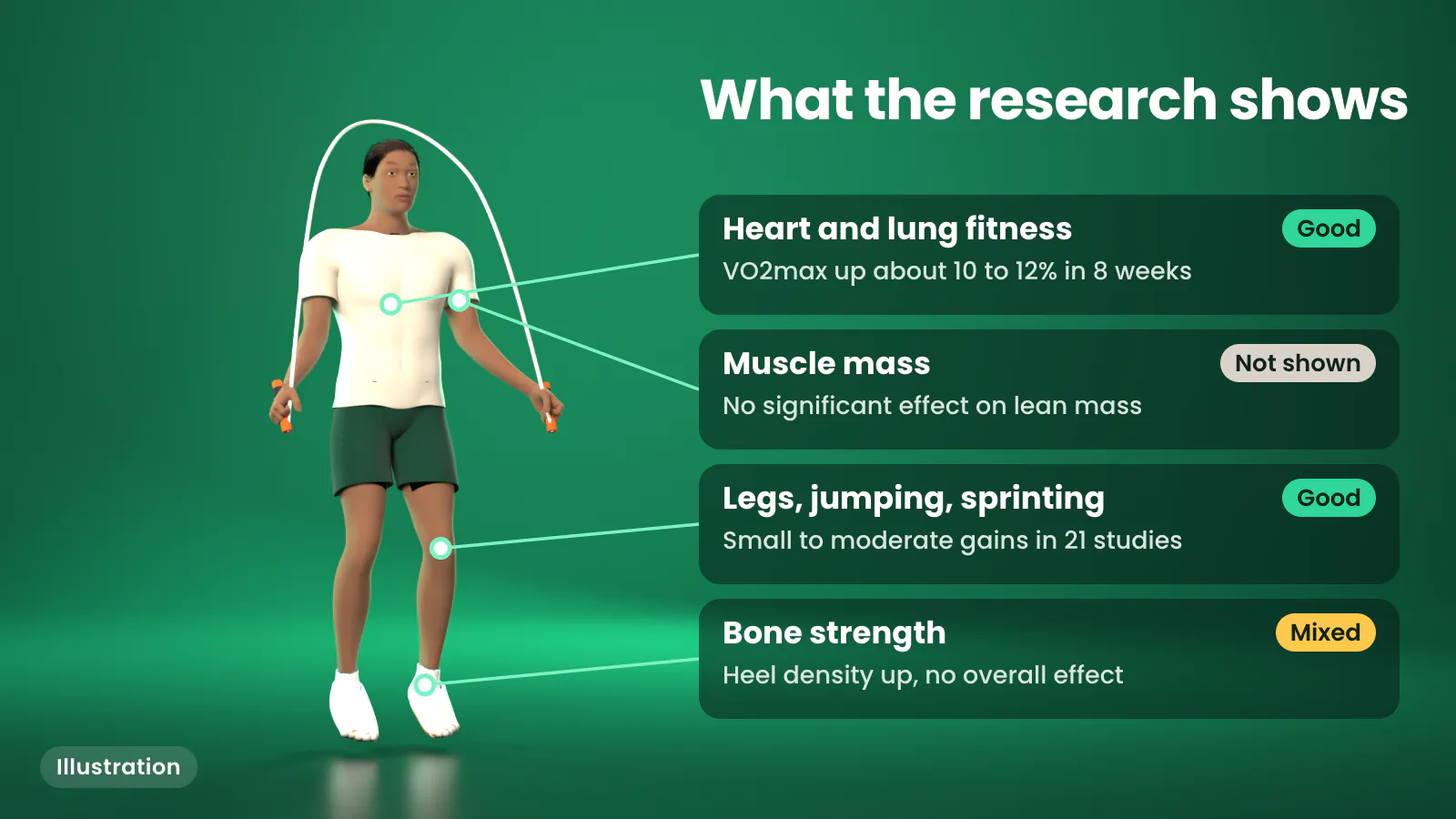
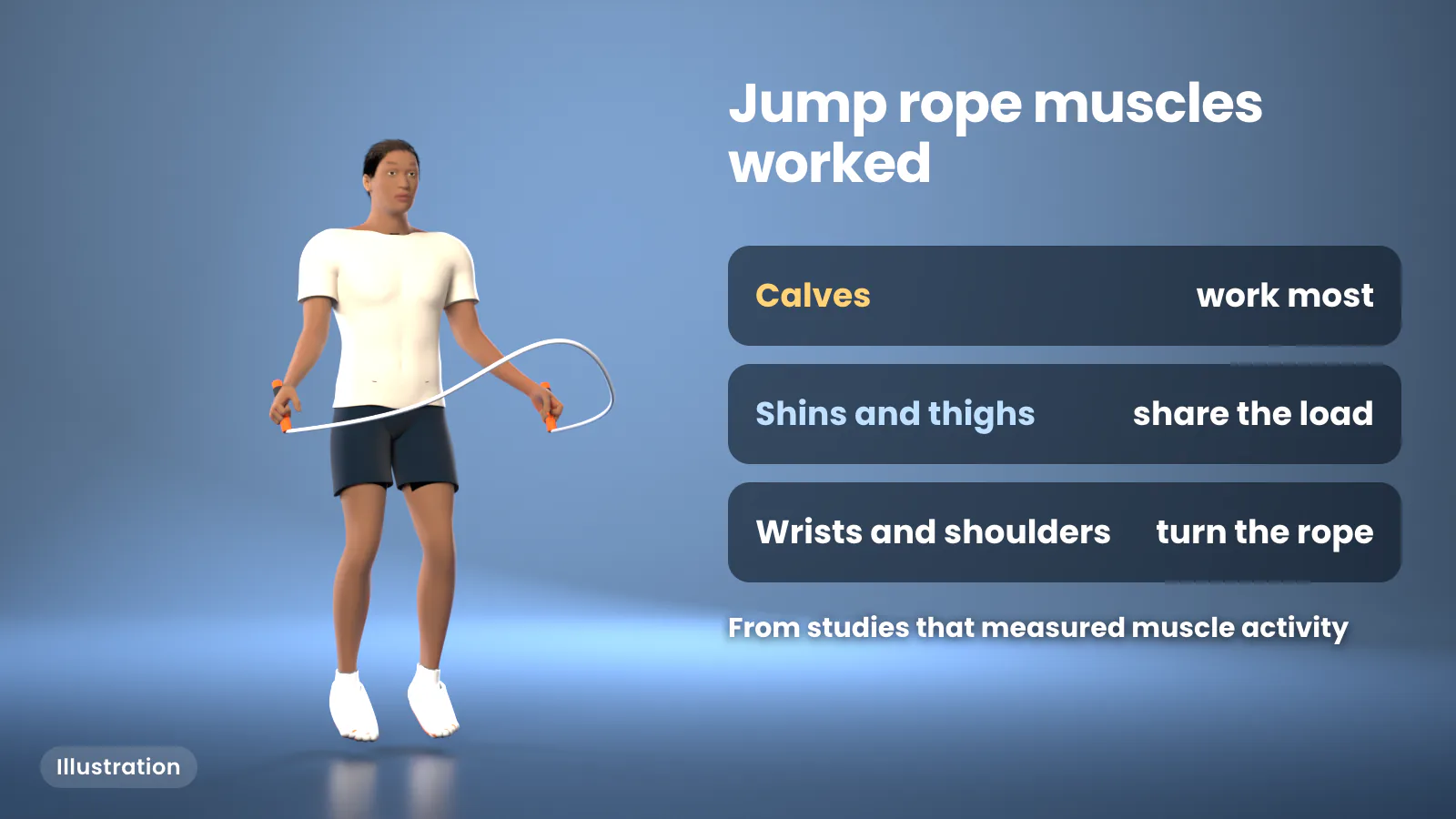
Jump rope works your calves hardest, along with the muscle at the front of the shin, because every hop is a quick push-off and landing on the balls of your feet. The thighs and hip flexors help absorb and lift, and the wrists and shoulders turn the rope. In a 2022 study, the two-foot bounce used the calves and shins more and landed more softly, while the alternate-foot step used the thighs and hips more. Rope training builds strength and spring, but a review of 21 studies found no significant gain in muscle mass.
Jump rope looks like a whole-body exercise, and in a way it is. But when researchers put sensors on the muscles of people skipping, the work clearly sits in the lower legs. Here is what two studies of muscle activity found, muscle by muscle, and what that means for your training.
The muscles, from most work to least
| Muscle | What it does when you skip | What the studies show |
|---|---|---|
| Calves (gastrocnemius) | Pushes you off the floor and absorbs each landing | Measured in both studies; more active in the two-foot bounce |
| Front of the shin (tibialis anterior) | Controls the foot as it lands | Measured in both studies; more active in the two-foot bounce |
| Front of the thigh (quadriceps) | Absorbs the landing at the knee | Measured in the 2025 study |
| Back of the thigh (hamstrings) | Steadies the knee and hip | Measured in both; more active in the alternate-foot step |
| Hip flexors (iliopsoas) | Lift the knee in stepping moves | More active in the alternate-foot step |
| Feet | Spring back from each landing | Arch stiffness improved after 10 weeks of rope training (2020) |
| Wrists, forearms, shoulders | Turn the rope and hold the arms in place | Small upper-body strength gains in a 2022 review |
The calves do most of it because a skip is a short, springy hop on the balls of the feet. In a 2025 study of 20 Muay Thai athletes skipping at 2.2 jumps a second (132 a minute), each landing kept them on the floor for only about 0.28 seconds.
Two-foot bounce or alternate-foot step?
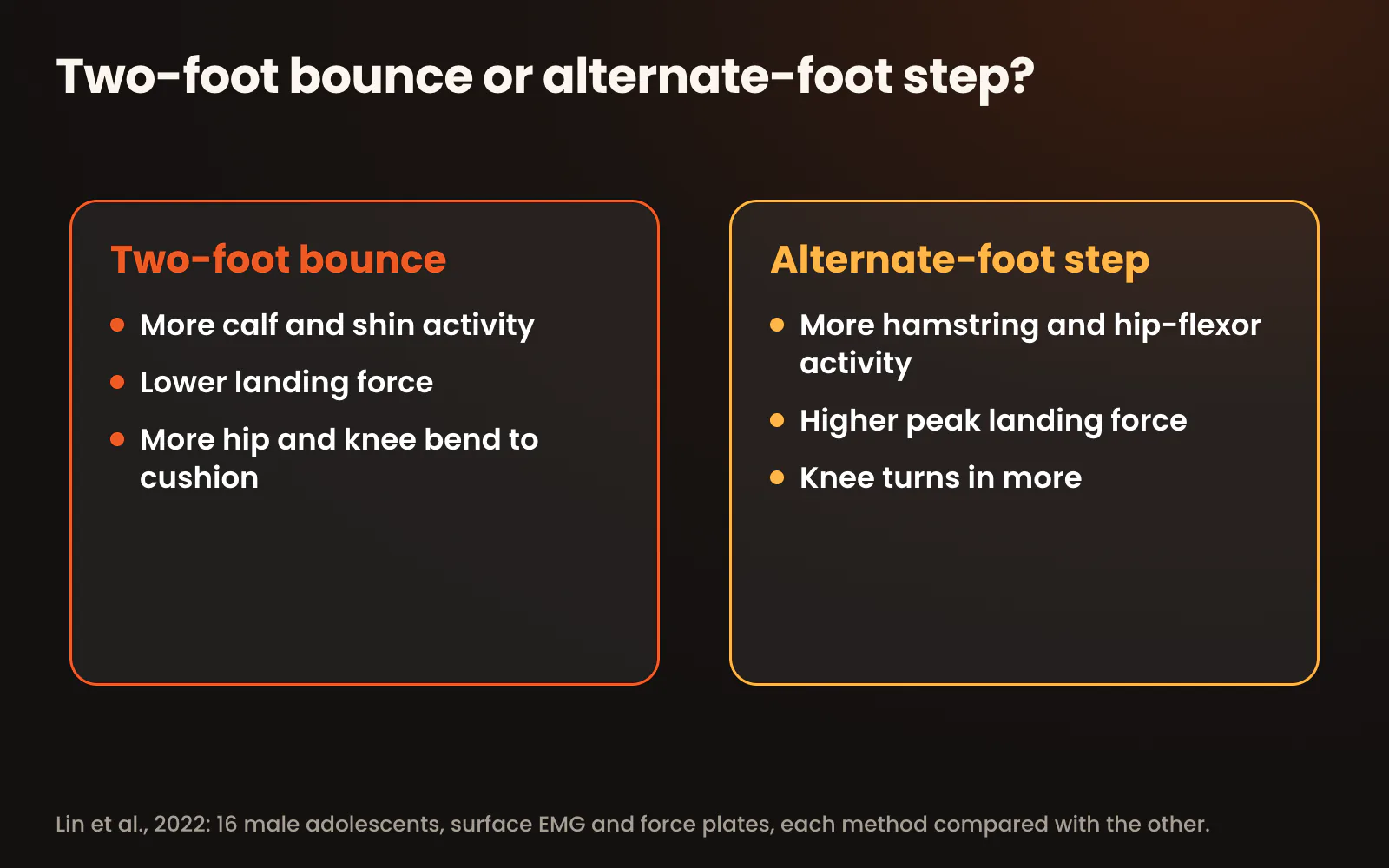
How you jump changes which muscles work. A 2022 study measured 16 male adolescents doing both moves:
- Two-foot bounce: more activity in the calf (the outer head of the gastrocnemius) and the front of the shin. The landing force was lower, and the hips and knees bent more, which cushions each landing.
- Alternate-foot step: more activity in the back of the thigh (semitendinosus) and the hip flexor (iliopsoas). The peak landing force and loading rate were higher, and the knee turned inward more.
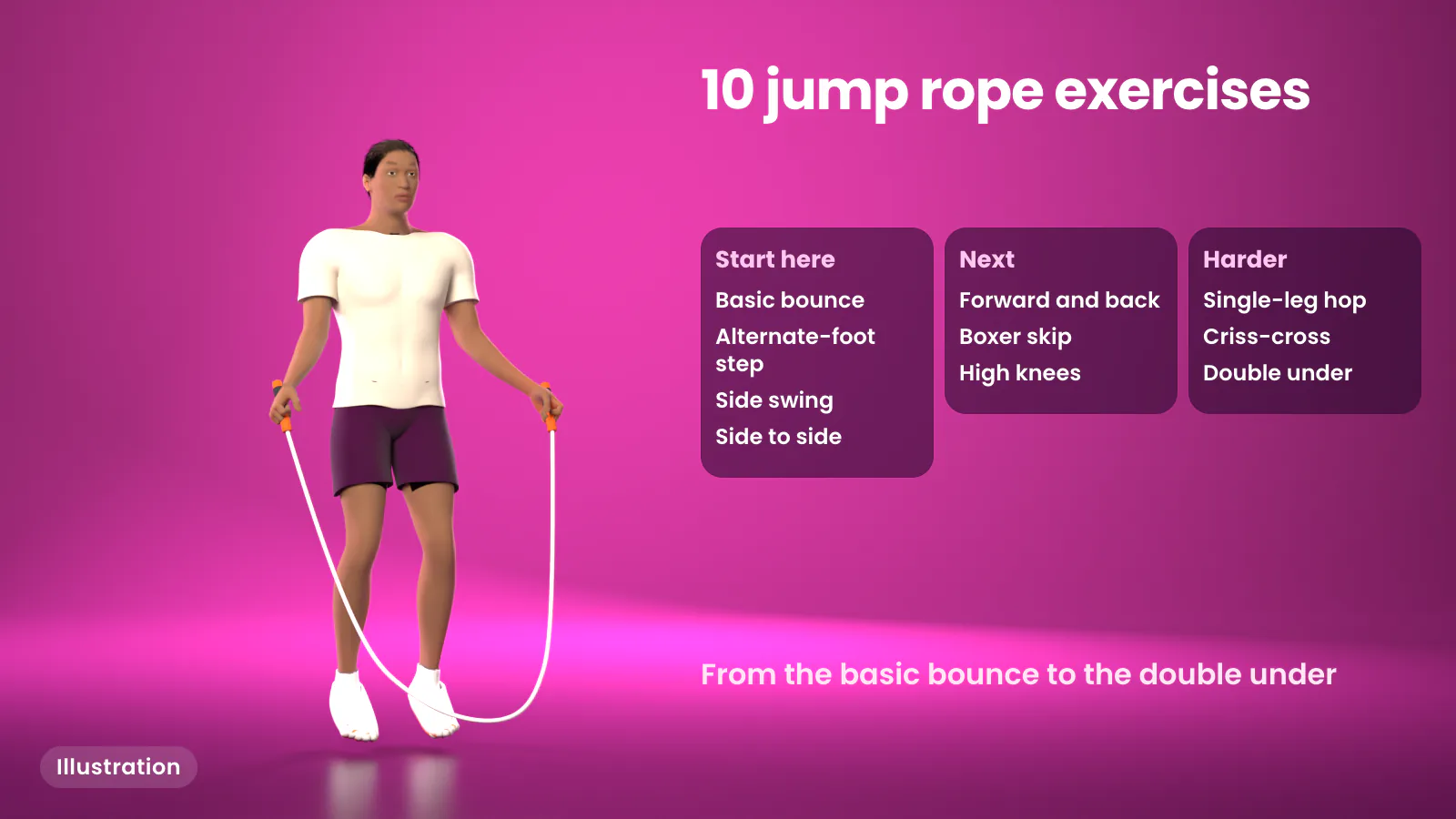
The authors concluded that the bounce leans on the calves and lands more gently, while the alternate step leans on the thighs. If you want your calves to do the work, or you want softer landings, stay with the two-foot bounce. To spread the load, mix in the alternate-foot step from our jump rope exercises.
One leg vs two legs
The 2025 Muay Thai study also compared skipping on one leg with skipping on both. Peak ground force was around 4.0 to 4.4 kN on two legs and around 2.8 to 3.2 kN on one, with no significant difference between men and women. Women, however, co-contracted the muscles on both sides of the knee and ankle more during one-leg skipping, which the authors read as a way of keeping the joints stable. They describe rope jumping as a practical drill for neuromuscular control.
Does jump rope build muscle?
Not much. A 2022 review of 21 studies with 1,021 participants, mostly under 18, found that rope training improved maximal strength in the lower and upper body and jumping ability by a small to moderate amount. It found no significant effect on lean mass or muscle endurance.
So jump rope makes your legs stronger and springier, not bigger. It is unlikely to give you bulky calves. If you want more muscle, add resistance training; see our benefits article for what the evidence supports.
If your calves are sore
Sore calves are normal at the start, because they do most of the work on every hop and are not used to hundreds of quick landings. Our suggestions:
- Build up slowly: short sets of 20 to 30 seconds with rests, a few times a week. Our beginner guide has a two-week start.
- Hop low: 2 to 3 cm is enough to clear the rope, and a lower hop means a smaller landing.
- Alternate the moves: switch between the two-foot bounce and the alternate-foot step to spread the load between the calves and thighs.
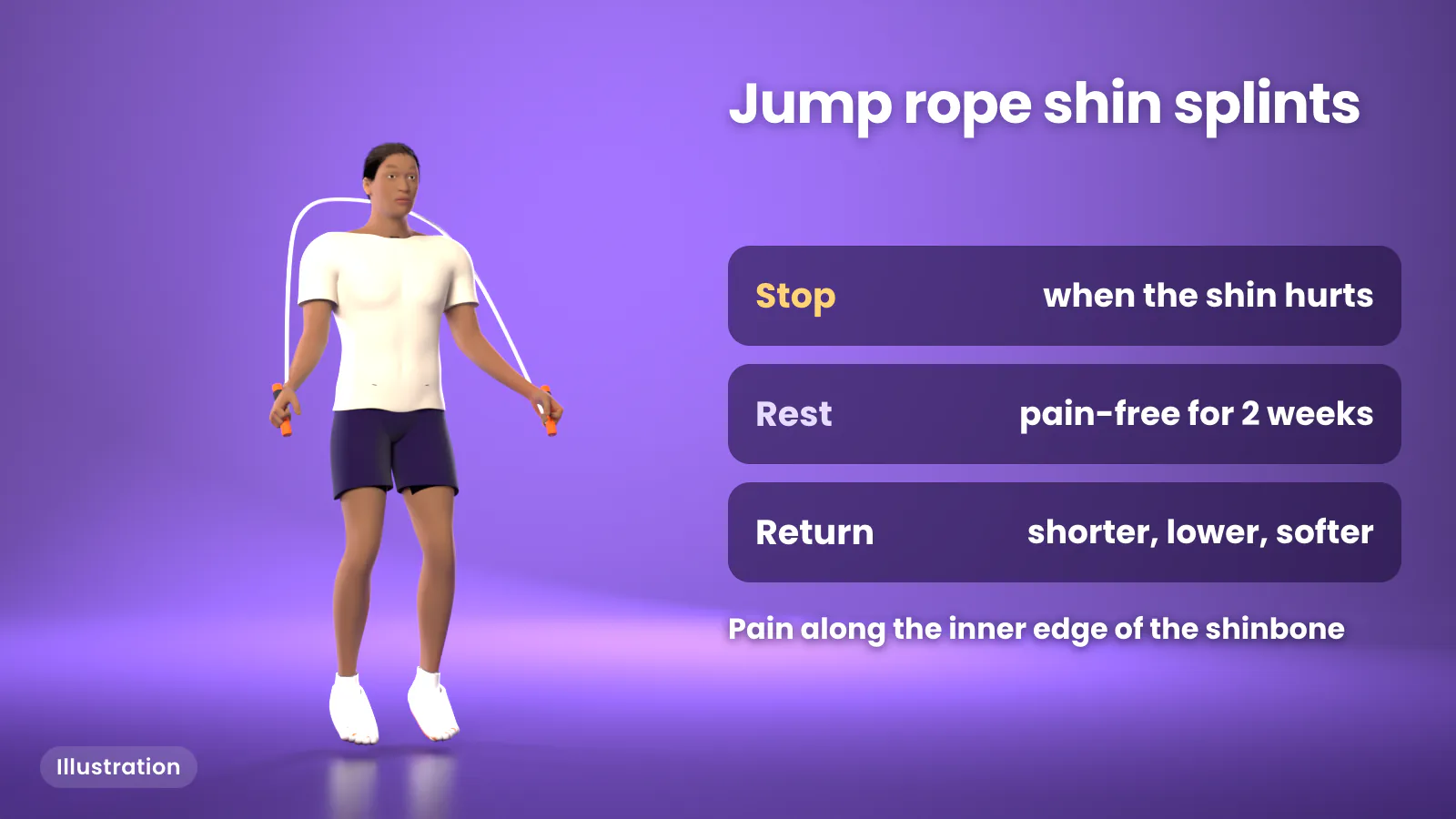
If pain is sharp, lasts for days or sits in a joint rather than the muscle, stop and check with a doctor or physiotherapist.
Track the load on your legs
Your calves adapt to the number of jumps, so it helps to know the number. SkipCount counts every jump with the iPhone camera and says the count out loud, then shows your total, your best set and your pace after each workout. Raising the count a little each week is a simple way to build up without overdoing it.
Download SkipCount and see how many jumps your legs do each session.
Questions
What muscles does jump rope work?+
Mainly the calves (gastrocnemius) and the muscle at the front of the shin (tibialis anterior). The front and back of the thigh and the hip flexors help absorb each landing and lift the legs, and the forearms and shoulders turn the rope.
Does jump rope build calf muscle?+
It works the calves hard, but it is poor at adding size. A 2022 review of 21 studies found that rope training improved strength and jumping but had no significant effect on lean mass. To build bigger calves, add resistance exercises such as calf raises with weight.
Does jump rope work your arms?+
A little. Your wrists and forearms turn the rope and your shoulders hold your arms in place. The same review found small gains in upper-body strength, but rope jumping is mainly a leg exercise.
Which works the calves more: two feet or alternating feet?+
Two feet. In a 2022 study of 16 adolescents, the two-foot bounce showed more calf and shin activity, while the alternate-foot step showed more activity in the back of the thigh and the hip flexors, with higher landing forces.
Why are my calves sore after jumping rope?+
Your calves do most of the work on every hop and are not used to that many quick landings. Start with short sets of 20 to 30 seconds with rests, a few times a week, and add time gradually as the soreness fades.
Sources
- Lin Y, et al. The influence of different rope jumping methods on adolescents' lower limb biomechanics during the ground-contact phase. Children, 2022 (checked 2026-11-17)
- Kaewjaratwilai T, et al. Are there sex differences in lower-limb biomechanics and muscle activation during rope jumping in Muay Thai athletes? Sports, 2025 (checked 2026-11-17)
- Singh U, et al. Jump rope training effects on health- and sport-related physical fitness in young participants: a systematic review with meta-analysis. J Sports Sci, 2022 (checked 2026-11-17)
- García-Pinillos F, et al. Jump-rope training: improved 3-km time-trial performance in endurance runners. Int J Sports Physiol Perform, 2020 (checked 2026-11-17)