Jump rope for seniors: is it safe after 60, what it does for bones, and how to start
 By Rupangkan KalitaPublished
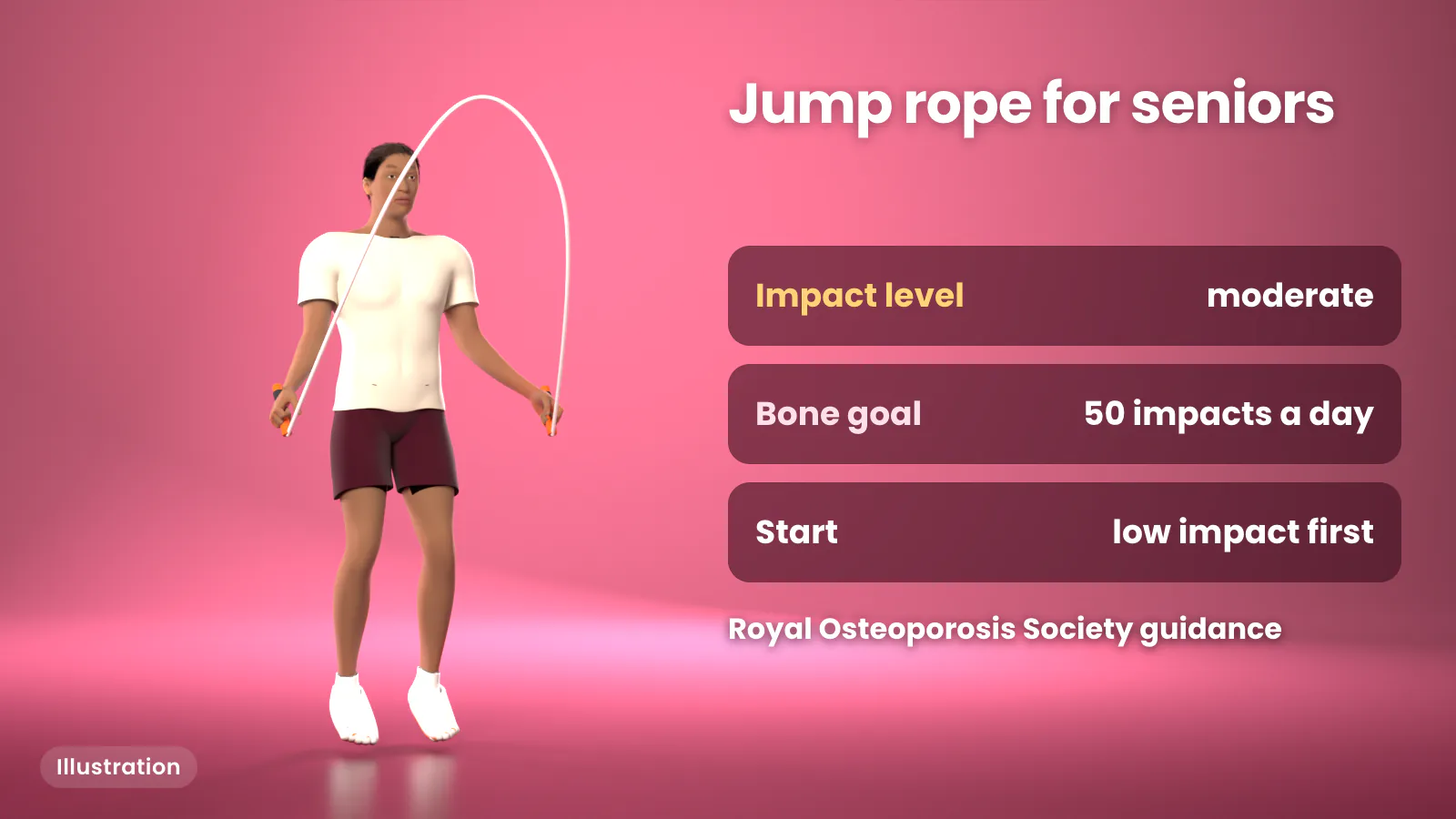
Many older adults can jump rope, but it is a moderate-impact exercise, so it suits people who are already steady on their feet and have no fractures that rule out impact. The Royal Osteoporosis Society lists skipping as moderate impact and suggests building up to about 50 moderate impacts on most days for bone strength if you have not had spinal fractures, starting from low-impact moves such as marching. No trial has tested jump rope in adults over 60, but a trial of supervised impact and strength training in women around 65 with low bone mass raised spine bone density by 2.9% in 8 months. Check with a doctor first if you have osteoporosis with fractures, heart or joint problems, or have fallen.
Jumping rope is often written off as a young person's exercise. For many older adults it can be a short, useful workout, and the impact that worries people is part of what helps bones. It also asks more of your balance, joints and heart than walking does. Here is what bone-health guidance says, what one trial in women around 65 found, who should check first, and a gentle way to start.
This page is general information. If you have a health condition, have fallen, or have not exercised for a while, talk to your doctor or a physiotherapist before you start.
What the guidance says
The NHS asks adults aged 65 and over to be active every day, to do activities that improve strength, balance and flexibility on at least 2 days a week, and to do 150 minutes of moderate activity a week, or 75 minutes of vigorous activity if they are already active.
For bones, the Royal Osteoporosis Society (ROS) sorts impact into levels:
| Level | What it means | Examples (ROS) |
|---|---|---|
| Low impact | One foot always stays on the ground | Walking, marching, stair climbing |
| Moderate impact | You push off and land; often both feet leave the ground | Jogging, skipping, dancing, tennis |
The ROS says everyone should do impact exercise if they are able, especially with osteoporosis:
- No spinal fractures: build up to about 50 moderate impacts on most days. One jump counts as one impact, and you can spread them through the day.
- Spinal fractures or several broken bones: it is usually best to stick to low impact and build up to 20 minutes on most days. Some people can move on to moderate impact; ask your doctor or physiotherapist.
- Other medical conditions: impact may not suit you, and strength exercise may be the better focus.
The ROS also notes that swimming and cycling help fitness but are not impact exercise, and that exercise does not replace osteoporosis medicine.
What a trial found
No trial we could find has tested jump rope in adults over 60. The closest evidence is the LIFTMOR trial, which tested supervised, high-intensity strength and impact training in 101 women aged about 65 with low bone mass.
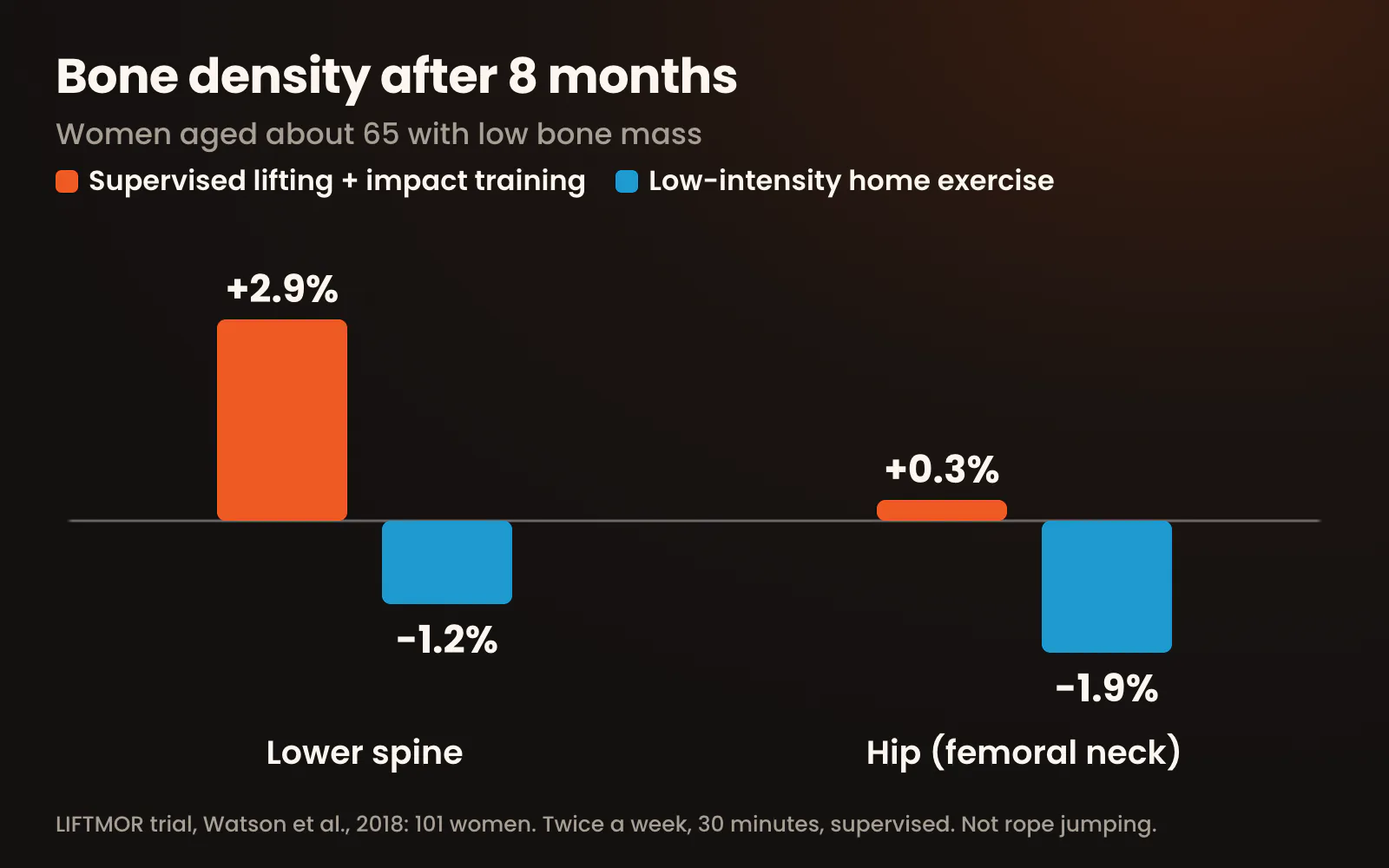
After 8 months of two supervised 30-minute sessions a week, the training group's lower-spine bone density rose by 2.9% while the home-exercise group's fell by 1.2%; at the hip it was +0.3% against -1.9%. Strength and functional tests such as standing up from a chair also improved more. There was one minor adverse event, a back spasm.
Two limits matter: the training was closely supervised, and it was heavy lifting plus impact moves, not skipping. It shows that impact under guidance can be done safely by women with low bone mass, not that unsupervised rope jumping does the same.
How hard is jump rope on the joints?
In a 2021 motion-lab study of young women, a two-foot bounce at 105 skips a minute produced higher ground reaction forces than walking but lower than running, with the same order for hip and knee loading. That fits the ROS label of moderate impact. There are no comparable measurements in older adults.
Check with a doctor first if you
- have osteoporosis with spinal fractures or several broken bones,
- have fallen recently or feel unsteady on your feet,
- have a heart or lung condition, or get chest pain or unusual breathlessness when active,
- have had a hip or knee replacement, or have painful knees, ankles or feet,
- have not been active for a long time.
A gentle way to start
Our suggestion, built on the ROS approach of starting low and building up:
- Low impact first (week 1 to 2). March on the spot, climb stairs and do heel drops: rise onto your toes, then drop onto your heels. A few minutes on most days.
- Small hops without a rope (week 2 to 3). Stand near a wall or a sturdy chair. Do sets of 5 to 10 small two-foot hops, landing softly on the balls of your feet, 2 to 3 cm off the floor.
- Add the rope, slowly. Turn the rope slowly and jump once per turn. Sets of 10 to 20 jumps with a rest between, on a forgiving floor such as wood or a mat, in supportive shoes.
- Build towards about 50 jumps a day. The ROS figure for bone strength. You can split it into 5 sets of 10 across the day. Go further only if your joints and balance are happy with it.
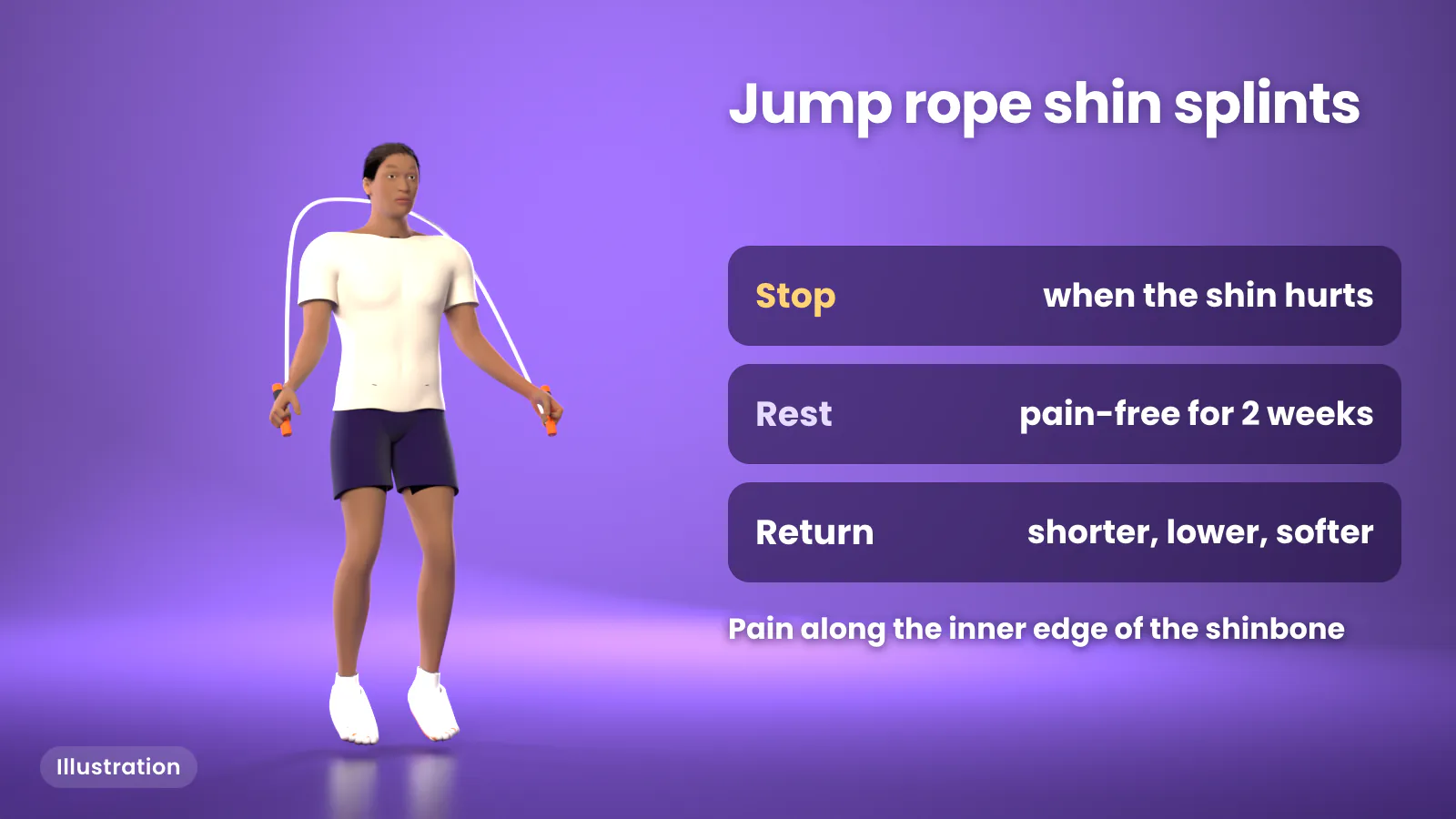
Stop if you feel pain in a joint or shin, dizziness, chest pain or unusual breathlessness. For more on form and rope size, see our guides to jump rope for beginners and jump rope length; if your shins hurt, read shin splints from jumping rope.
If the rope isn't for you
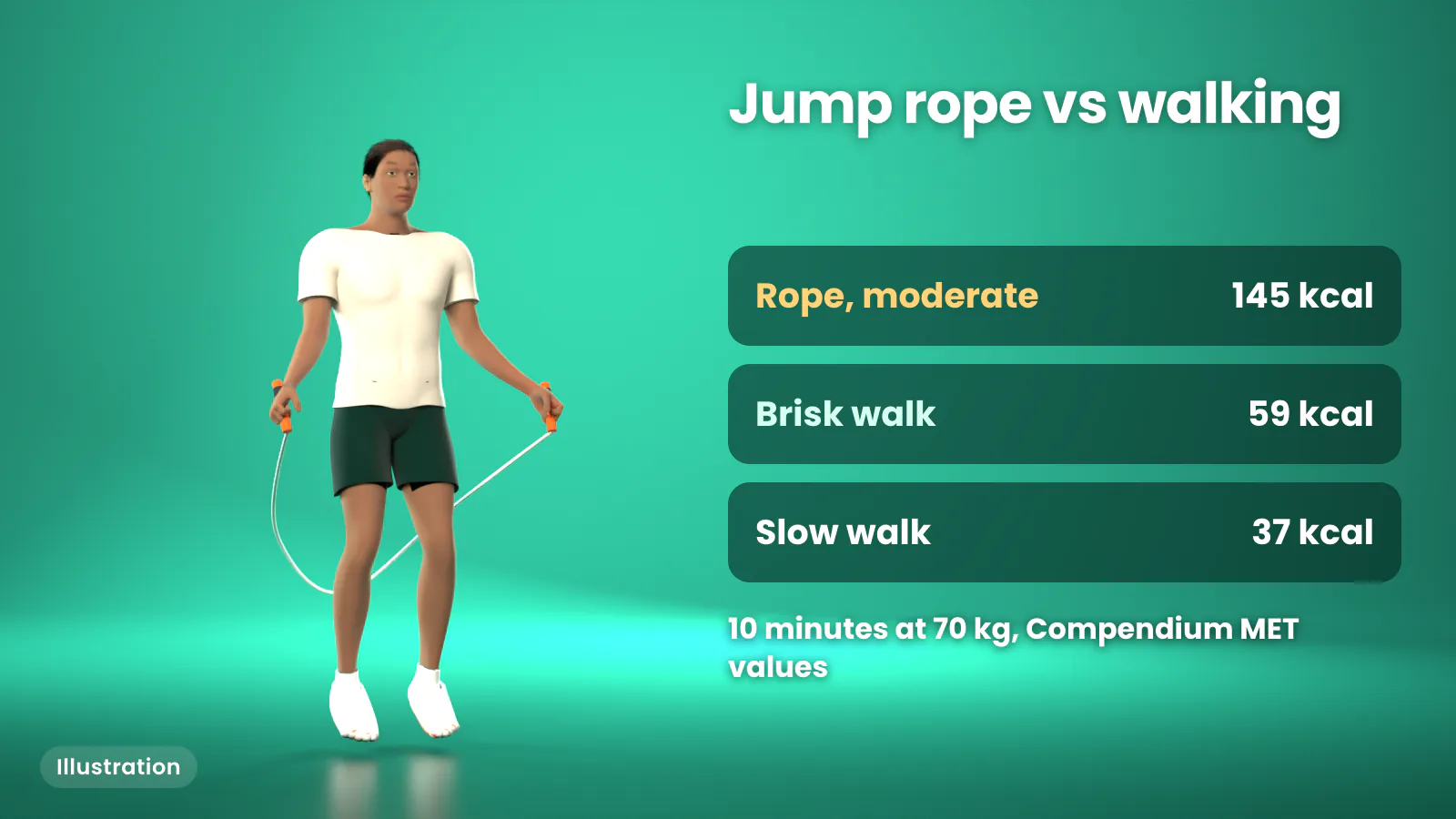
Brisk walking, marching and stair climbing are low-impact options that still load the bones, and walking is easy to do every day. Our jump rope vs walking comparison shows how they stack up per minute.
Count your 50
Building to a daily number is easier when you know how many you did. SkipCount counts every jump with the iPhone camera and says the count out loud, so you can stop at 10 without counting in your head, and see each set when you finish. Your first 3 workouts are free; after that, counting, timers and full history are part of SkipCount Pro.
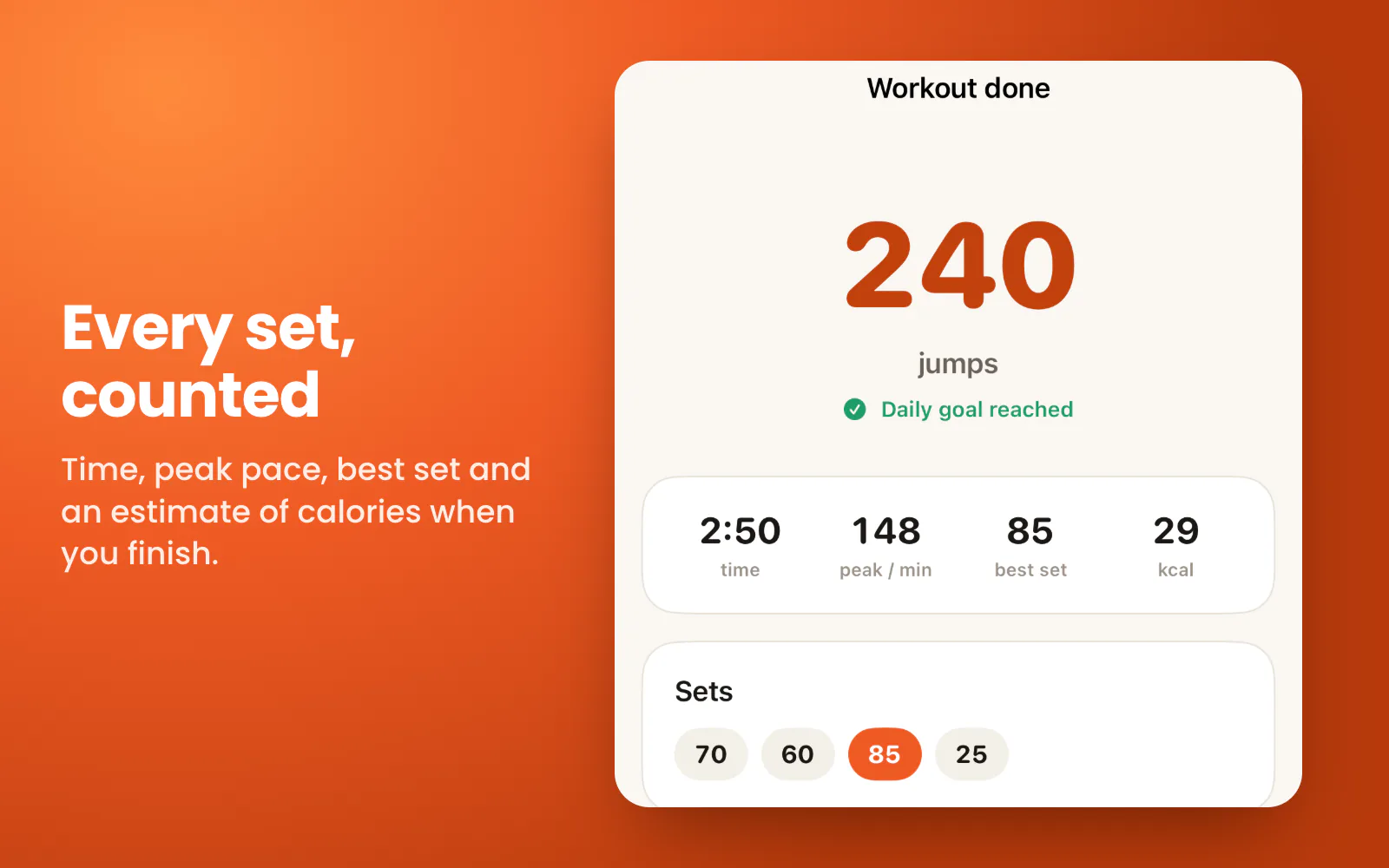
Download SkipCount and count your first sets.
Questions
Is jumping rope safe for seniors?+
For many healthy older adults, yes, if they build up slowly. It is a moderate-impact exercise: both feet leave the ground and land with more force than walking. It is less suitable if you have had spinal fractures or several broken bones, have balance problems or have fallen recently, or have heart or joint conditions; check with a doctor or physiotherapist first.
Is jump rope good for bones as you age?+
Impact helps bones. The Royal Osteoporosis Society lists skipping as a moderate-impact exercise that can help improve bone strength, and suggests building up to about 50 moderate impacts on most days if you have not had spinal fractures. One jump counts as one impact. Exercise does not replace osteoporosis medicine if you have been prescribed it.
How many jumps a day should an older adult do?+
For bone strength, the Royal Osteoporosis Society suggests building up to about 50 moderate impacts on most days, spread through the day if you like. Start lower, with low-impact moves such as marching and heel drops, and add jumps in small sets of 5 to 10.
Can you start jumping rope at 60 or 70?+
Many people can, as long as they start gently. Practise small two-foot hops without a rope first, near a wall or sturdy chair, then add the rope at a slow pace. If you have not exercised for a while, have a health condition or are unsure, ask your doctor first.
What are alternatives to jump rope for seniors?+
Low-impact options that still load the bones include brisk walking, marching on the spot, stair climbing and heel drops. Swimming and cycling are good for fitness but are not impact exercises, so they do little for bone strength.
Sources
- Royal Osteoporosis Society: Impact exercise to help make your bones stronger (checked 2026-11-21)
- Royal Osteoporosis Society: Exercise for bones (checked 2026-11-21)
- NHS: Physical activity guidelines for older adults (checked 2026-11-21)
- Watson SL, et al. High-intensity resistance and impact training improves bone mineral density and physical function in postmenopausal women with osteopenia and osteoporosis: the LIFTMOR randomized controlled trial. J Bone Miner Res, 2018 (checked 2026-11-21)
- Mullerpatan R, et al. Lower extremity joint loading during bounce rope skip in comparison to run and walk. J Bodyw Mov Ther, 2021 (checked 2026-11-21)