Jump rope vs walking: calories per minute, joint load and which is better for you
 By Rupangkan KalitaPublished
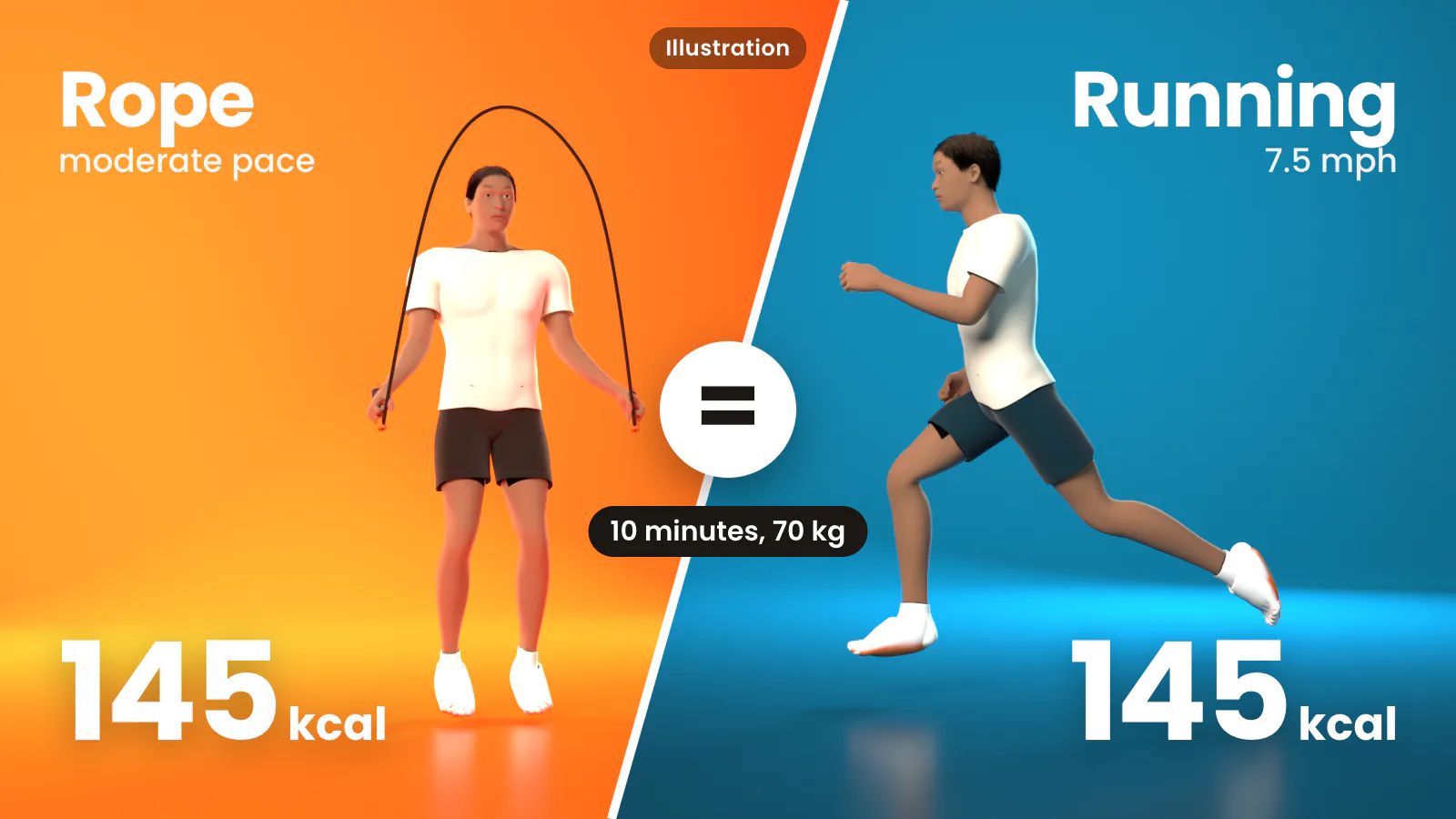
Minute for minute, jumping rope burns about 2.5 times as much as brisk walking: 11.8 METs at a moderate 100 to 120 skips a minute against 4.8 METs for walking at 3.5 to 3.9 mph. For a 70 kg person that is about 145 kcal against 59 kcal in 10 minutes, so about 12 minutes on the rope matches a 30-minute brisk walk. Walking is easier on the joints and easy to do for an hour; rope is the faster workout. Many people do best with both.

Jump rope vs walking is a fair fight between a fast, intense workout and the easiest exercise there is. Per minute the rope wins clearly. Over a week, walking catches up because you can do far more of it. Here are the numbers from the 2024 Adult Compendium of Physical Activities, what each does to your joints, and how to pick.
Which burns more calories per minute?
A MET value says how many times more energy an activity takes than sitting still. Calories per minute are MET × 3.5 × body weight in kg ÷ 200. The table uses a 70 kg (154 lb) person over 10 minutes.
| Activity | Pace | METs | kcal in 10 minutes (70 kg) |
|---|---|---|---|
| Walking | 2.5 mph, 4 km/h | 3.0 | 37 |
| Walking | 2.8 to 3.4 mph, 4.5 to 5.5 km/h | 3.8 | 47 |
| Brisk walking | 3.5 to 3.9 mph, 5.6 to 6.3 km/h | 4.8 | 59 |
| Very brisk walking | 4.0 to 4.4 mph, 6.4 to 7.1 km/h | 5.5 | 67 |
| Rope, slow | under 100 skips a minute | 8.3 | 102 |
| Rope, moderate | 100 to 120 skips a minute | 11.8 | 145 |
| Rope, fast | 120 to 160 skips a minute | 12.3 | 151 |
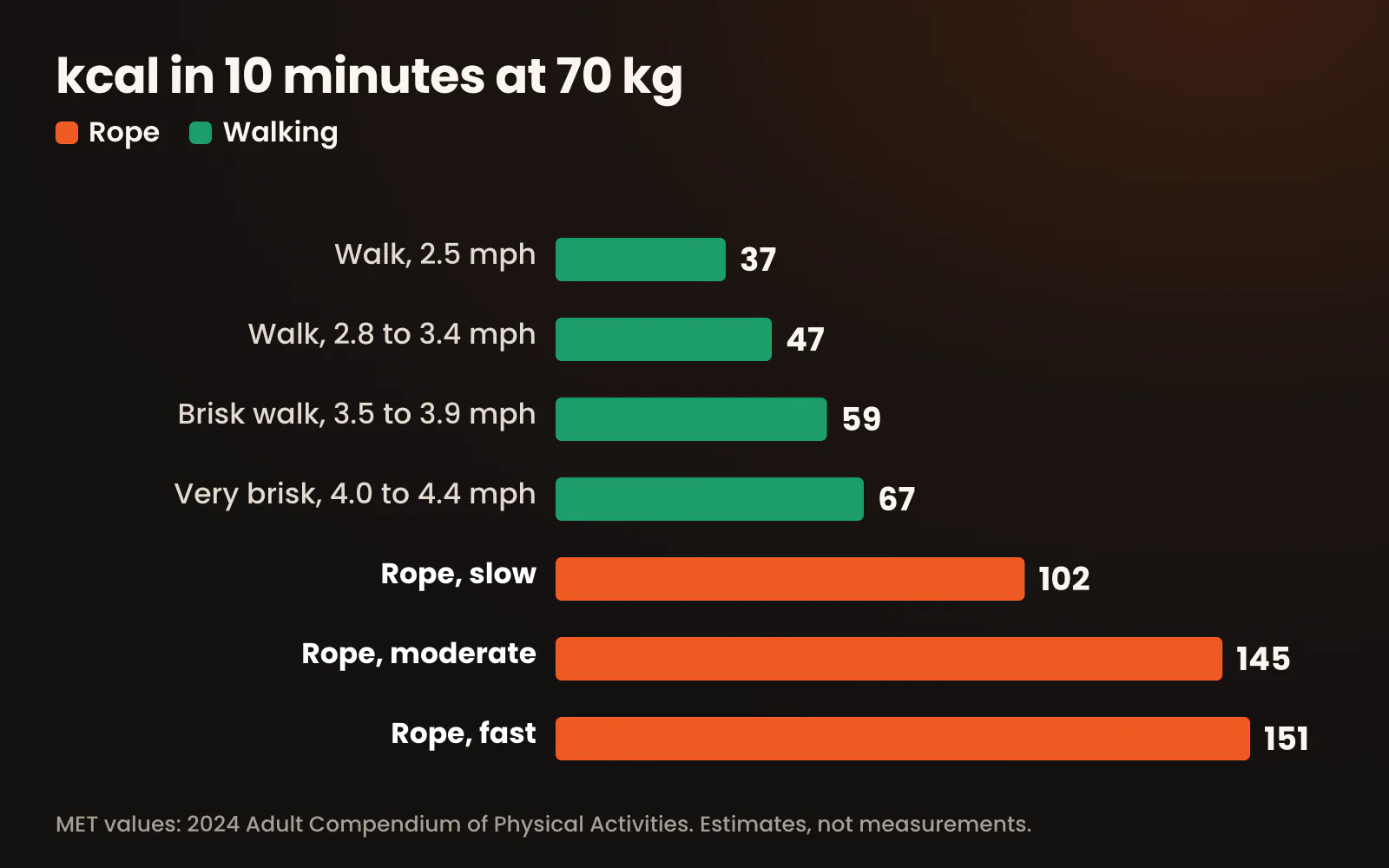
Even slow skipping burns more each minute than the fastest walking pace in the table. A moderate pace on the rope takes about 2.5 times the energy of brisk walking. Put your own weight into the jump rope calorie calculator to see your numbers.
How long does each take?
The rope's advantage is time. For a 70 kg person:
- 10 minutes of moderate skipping (about 145 kcal) matches about 25 minutes of brisk walking.
- A 30-minute brisk walk (about 176 kcal) matches about 12 minutes of actual jumping. Add rests between sets and the session takes longer, but still well under 30 minutes.
Walking wins on how long you can keep going. Most people can walk for an hour without stopping, while rope sessions run in sets of a minute or a few. If you have an hour, a long walk can burn more than a short rope session; if you have 15 minutes, the rope gets more done.
Weekly targets: one rope minute counts about double
The WHO recommends 150 to 300 minutes a week of moderate activity, or 75 to 150 minutes of vigorous activity, or a mix. The CDC calls activity of 3 to under 6 METs moderate and 6 METs or more vigorous. Brisk walking (4.8 METs) is moderate; rope jumping (8.3 to 12.3 METs) is vigorous.
So by the guidelines, about 75 minutes of jumping a week does the job of about 150 minutes of brisk walking. That is 15 minutes on five days, against 30 minutes of walking on five days.
Steps: what walking gives you all day
Walking has something the rope can't match: you can add it to everything else you do. A 2025 review in The Lancet Public Health pooled 57 studies on daily steps. Compared with 2,000 steps a day, about 7,000 steps went with a 47% lower risk of death from any cause, with most of the benefit gained by 5,000 to 7,000 steps. These are observational studies: they show a link, not proof that steps alone caused it.
A few minutes of rope does not replace a day of moving around. A daily walk and a short rope session do different jobs.
Joints: rope sits between walking and running
In a 2021 motion-lab study, 22 young women did a two-foot bounce at 105 skips a minute, walked and ran over force plates. The bounce produced higher ground reaction forces than walking and lower than running, and the same order held for loading at the hip and knee. The authors concluded that the bounce keeps hip and knee loads low compared with running.
In practice:
- Walking is the gentlest of the three. It is the better start if you are very unfit, carry a lot of extra weight, or have knee, ankle or back problems; ask a doctor if you are unsure.
- Rope is more load than walking but less than running. Keep hops low, use the right rope length and a forgiving floor, and build up in short sets as in our guide for beginners.
Which should you pick?
| Jump rope | Walking | |
|---|---|---|
| Calories per minute (70 kg) | 102 to 151 kcal per 10 minutes | 37 to 67 kcal per 10 minutes |
| Intensity | Vigorous | Light to moderate |
| Joint load | Higher than walking, lower than running | Lowest |
| Skill | Takes a few sessions to get the timing | None |
| Space | A few square metres and enough ceiling height | A route or a treadmill |
| How long you can keep going | Sets of a minute or a few | An hour or more |
- Short on time, stuck indoors, or want a harder workout: jump rope.
- Just starting, carrying a lot of extra weight, or have sore joints: walk first, then add short rope sets.
- Best of both: walk every day for your steps, and add two or three short rope sessions a week. Our jump rope benefits page shows what those sessions did in studies.
For weight loss, neither has a special effect. What adds up is the energy you burn over weeks and what you eat; see jump rope for weight loss. For the harder comparison, read jump rope vs running.
Count the rope minutes
A walk gets counted in steps without you thinking about it. Rope sessions are easy to overestimate, because rests between sets pile up. SkipCount counts every jump with the iPhone camera, shows your pace live and estimates calories for the time you were actually jumping, so you know how many vigorous minutes you really did. Your first 3 workouts are free; after that, counting, timers and full history are part of SkipCount Pro.
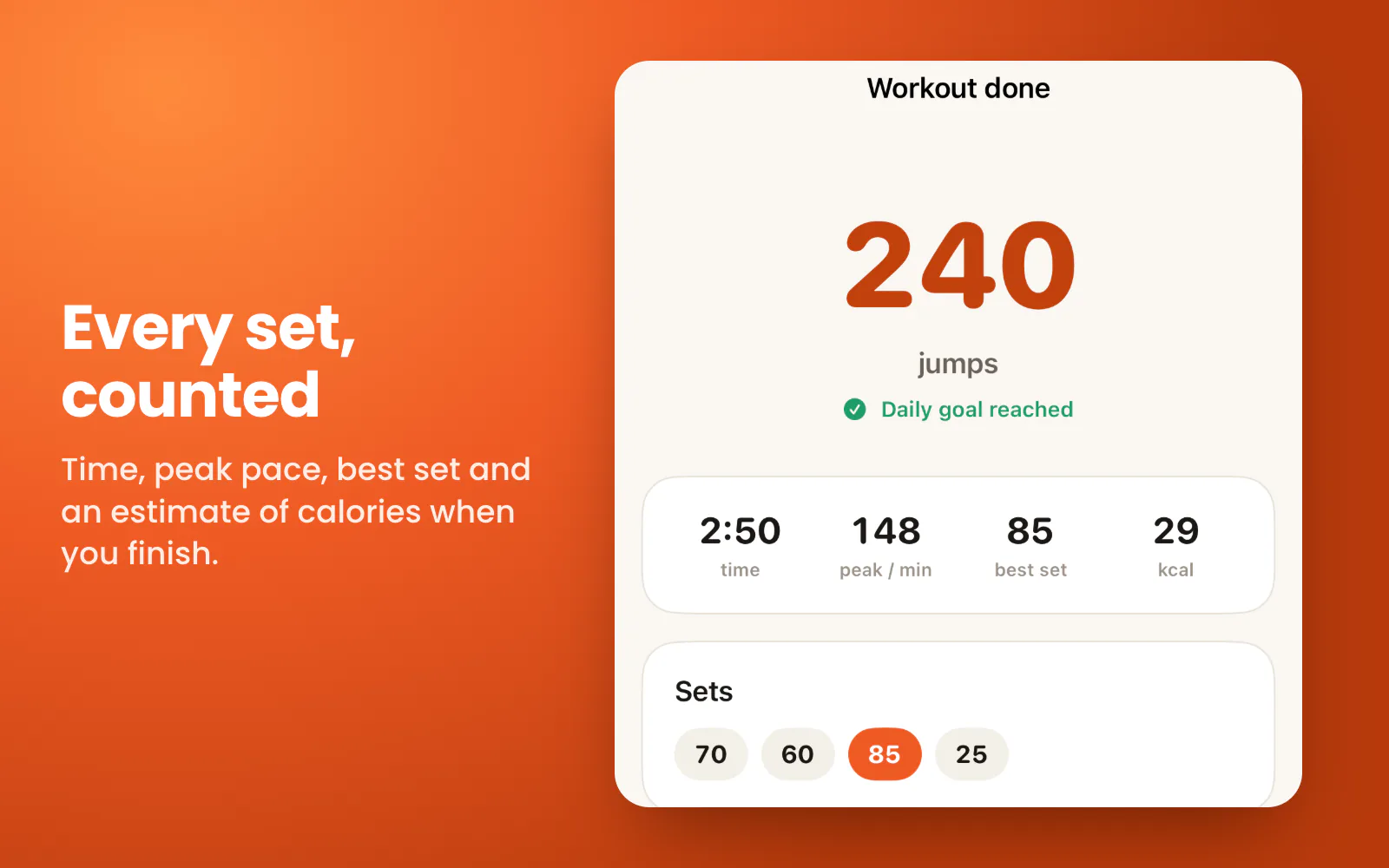
Download SkipCount and count your next rope session.
Questions
Is jump rope better than walking?+
For calories per minute and fitness in little time, yes: moderate rope jumping takes about 2.5 times the energy of brisk walking. Walking puts less load on the joints, needs no skill and is easy to keep up for long periods, so it is the better start for many beginners. The best choice is the one you will keep doing.
How many minutes of walking equal 10 minutes of jump rope?+
Using Compendium MET values, 10 minutes of moderate skipping (about 145 kcal at 70 kg) matches about 25 minutes of brisk walking at 3.5 to 3.9 mph. Going the other way, a 30-minute brisk walk matches about 12 minutes of actual jumping.
Is jump rope or walking better for weight loss?+
Both work if they add up to more energy burned over weeks, with what you eat mattering as much. Rope burns more per minute; walking is easier to do every day and for longer. Pick by the total minutes you will really do.
Is jump rope harder on the knees than walking?+
Yes, a little. In a 2021 motion-lab study of 22 young women, a two-foot bounce at 105 skips a minute produced higher ground reaction forces and hip and knee loading than walking, but lower than running. Start with short sets, low hops and a forgiving floor.
Does jump rope count toward the weekly activity target like walking?+
Yes, and each minute counts more. The WHO suggests 150 to 300 minutes of moderate activity such as brisk walking a week, or 75 to 150 minutes of vigorous activity. Rope jumping is vigorous, so one minute on the rope counts about like two minutes of brisk walking.
Sources
- 2024 Adult Compendium of Physical Activities: Walking (codes 17151 to 17230) (checked 2026-11-19)
- 2024 Adult Compendium of Physical Activities: Sports (rope jumping, codes 15550 to 15552) (checked 2026-11-19)
- Bull FC, et al. World Health Organization 2020 guidelines on physical activity and sedentary behaviour. Br J Sports Med, 2020 (checked 2026-11-19)
- CDC: Measuring physical activity intensity (checked 2026-11-19)
- Ding D, et al. Daily steps and health outcomes in adults: a systematic review and dose-response meta-analysis. Lancet Public Health, 2025 (checked 2026-11-19)
- Mullerpatan R, et al. Lower extremity joint loading during bounce rope skip in comparison to run and walk. J Bodyw Mov Ther, 2021 (checked 2026-11-19)