Double dutch jump rope: how to jump in, turn and practise
 By Rupangkan KalitaUpdated
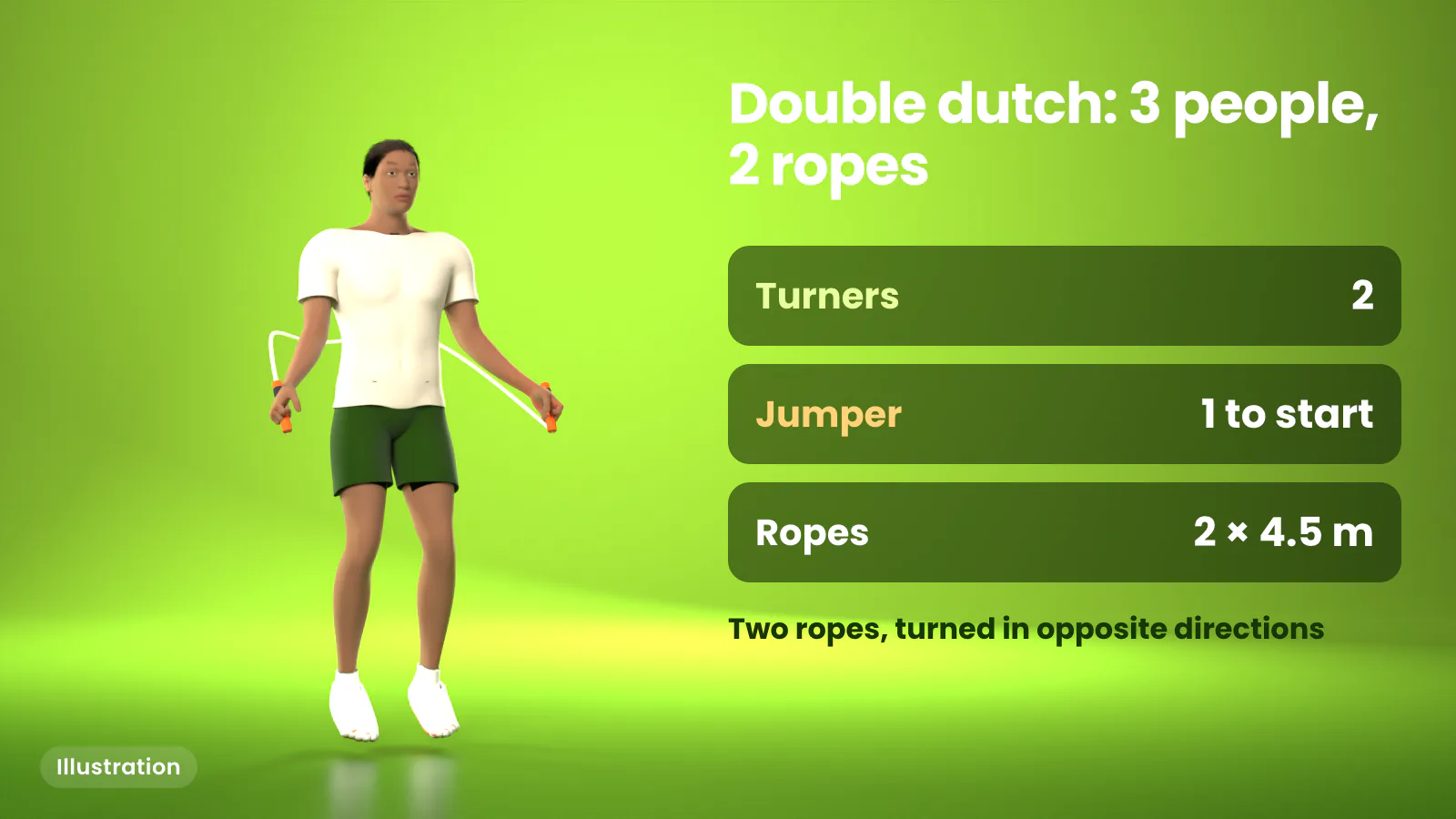
Double dutch takes 3 people: two turners swing two long ropes in opposite directions, one after the other, and a jumper hops over each rope as it reaches the floor. Teaching sets often use two 4.5 m ropes. Go in from the end, standing next to a turner, and step in on the count "one, and, two, and, step". Learn the basic bounce with your own rope first.
Double dutch is jump rope as a team game: two people turn two long ropes and a third jumps in the middle. It looks fast, but the jumping itself is close to the basic bounce. The hard part is getting in, and that can be learned in steps.
How double dutch works
You need 3 people and 2 ropes of the same length:
- Two turners stand facing each other, each holding one end of both ropes.
- The ropes turn in opposite directions, one after the other, so they reach the floor in turn. The turners' job is an even beat.
- One jumper goes in and hops over each rope as it reaches the floor, keeping the hops low.
Teaching sets often use ropes of 4.5 m each. In competition, the rules of the International Jump Rope Union (IJRU) allow ropes of any length, with one set of two ropes per team.
Where to stand and when to go in
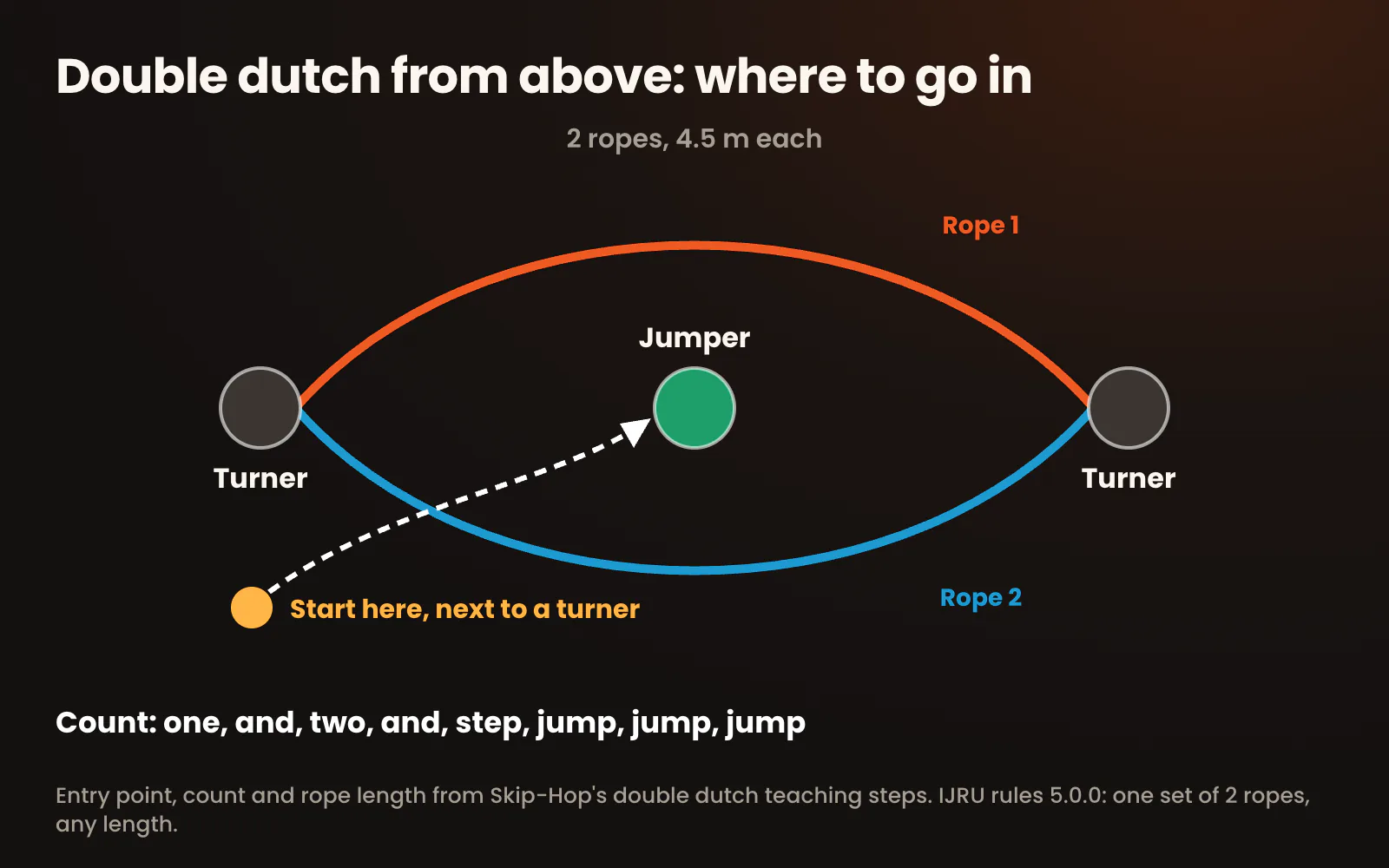
The UK skipping site Skip-Hop teaches the way in like this:
- Stand at the end, next to a turner, not at the side of the ropes.
- Watch and listen until you hear the ropes hit the floor in an even beat.
- Count yourself in: "one, and, two, and, step, jump, jump, jump". Step toward the middle on "step" and start jumping straight away.
Learn it in steps
Our suggested order, built on Skip-Hop's progression:
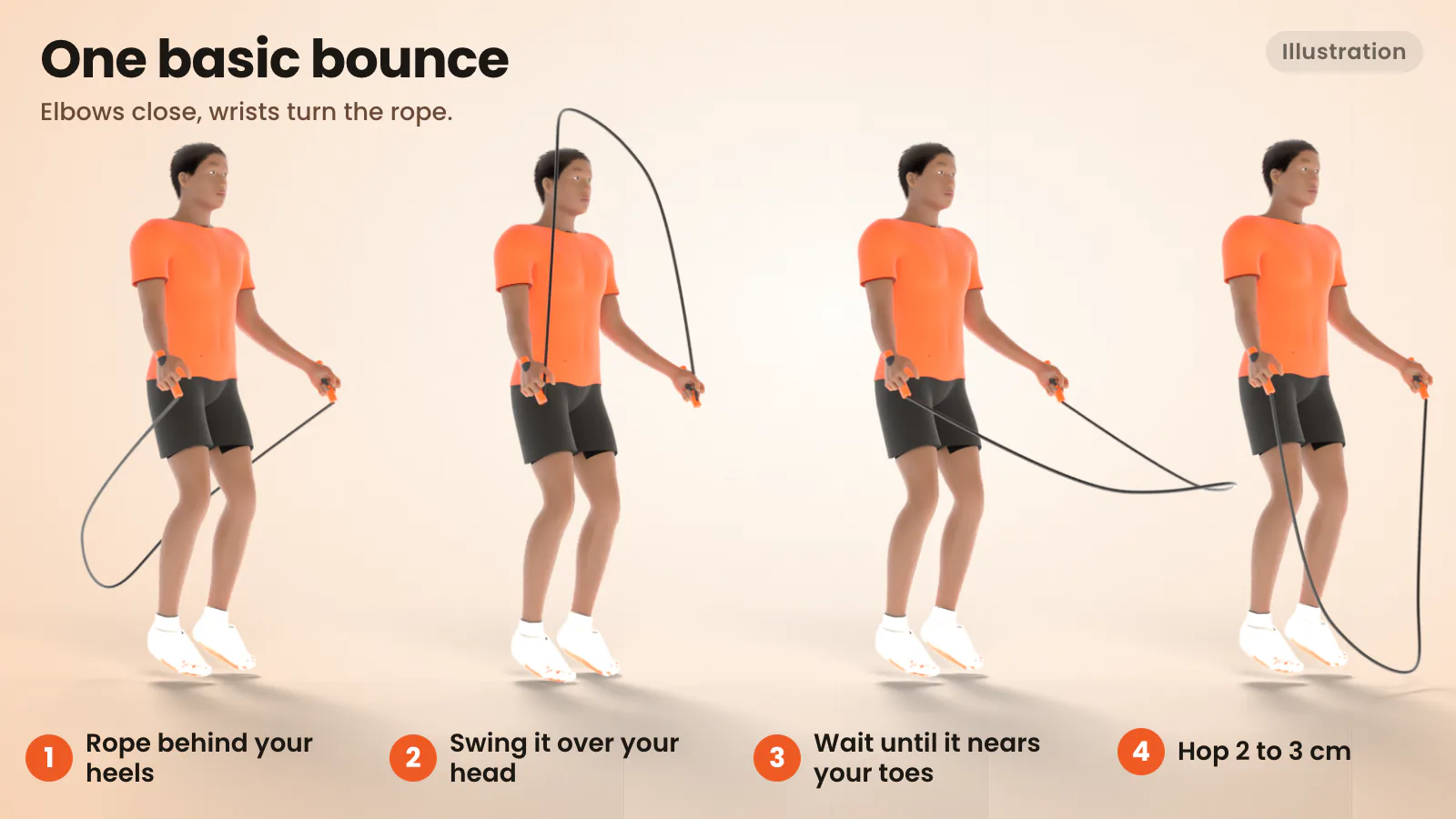
- Basic bounce with your own rope. Skip-Hop puts forward skipping with a single bounce before double dutch. Our beginner guide covers it.
- Start inside. Stand in the middle before the ropes turn, then let the turners start. You learn the jumping rhythm without the entry. Skip-Hop's Red Award test is to jump in and bounce 4 times.
- Mark the floor. Put a mark next to a turner where you stand, and one in the middle where you land.
- Step and jump. Practise the count from the mark, with a friend tapping you in on "step" if it helps.
- Stay in longer. Once 4 bounces are easy, aim for 10, then 20. Count them out loud.
Turning well
Our tips for the turners:
- Keep the beat even. The jumper times everything from the sound of the ropes on the floor.
- Keep both ropes the same size, so they reach the floor at the same spot in the middle.
- Stand far enough apart that each rope just touches the floor in the middle.
- Swap roles. Turning is half of the game, and a jumper who has turned knows what the beat should sound like.
Is double dutch a good workout?
For the jumper, yes: you jump continuously while you are in, much like the basic bounce. Rope jumping in the 2024 Compendium of Physical Activities is vigorous at every pace (8.3 METs and up), though it lists no separate value for double dutch. In a group, everyone jumps in short turns and rests while turning, so it works more like an interval session. Our beginner routines use the same on-and-off pattern.
Where double dutch came from
The National Double Dutch League (NDDL) traces the game's possible origins to ancient ropemakers in Phoenicia, Egypt and China, and calls it a street game. In 1973 two New York City police detectives, David A. Walker and Ulysses Williams, began developing it into a team sport with physical education teachers. On February 14, 1974, the first double dutch tournament was held, with nearly 600 students in grades 5 to 8. The American Double Dutch League, the sport's first governing body, was formed the same year.
Practise the solo skills between sessions
Double dutch needs three people, but the skills under it don't. The basic bounce, low hops and the alternate-foot step from our jump rope exercises can all be practised alone.
SkipCount counts single-rope jumping with the iPhone camera and says the count out loud, so you can see how long you hold the basic bounce before your next double dutch session. It is built for one jumper with one rope, and we have not tested it on double dutch. Your first 3 workouts are free; after that, counting, timers, goal mode and full history are part of SkipCount Pro.
Download SkipCount and build your basic bounce before you jump in.
Questions
How many people do you need for double dutch?+
Three: two turners and one jumper. More jumpers can join once the first one is in, but beginners should go in one at a time. Take turns, so everyone learns to turn as well as jump.
How long should double dutch ropes be?+
The competition rules of the International Jump Rope Union allow ropes of any length, as long as a team uses one set of two. Teaching sets are often 4.5 m each. Both ropes in a set should be the same length.
How do you jump into double dutch?+
Stand at the end, next to a turner, and watch the ropes hit the floor until you hear the beat. Step toward the middle on the count and start jumping straight away. A count such as "one, and, two, and, step, jump" helps you time it.
Why is double dutch so hard at first?+
Timing the way in. Jumping inside the ropes is close to a normal bounce, but going in means reading two ropes at once. Skip-Hop's teaching steps let a beginner start inside the ropes before they turn, so you can learn the jumping before the entry.
Where did double dutch come from?+
The National Double Dutch League calls it a street game with old roots, and credits two New York police detectives, David A. Walker and Ulysses Williams, with turning it into a team sport in 1973. The first tournament, on February 14, 1974, had nearly 600 school students.
Sources
- Skip-Hop: Double Dutch skipping (detailed teaching steps) (checked 2026-11-15)
- IJRU Rule Book 5.0.0, Competition Manual: Standards (checked 2026-11-15)
- National Double Dutch League: History (checked 2026-11-15)